IN 1904 THE WASIF Manzil, a palace in Murshidabad (West Bengal, India) was restored after an earthquake had badly damaged it in 1897. The palace was built for Sir Sayyid Wasif Ali Mirza Khan Bahadur (1875-1959), who became Nawab of Murshidabad in 1906. It was designed by a Britisher, Mr Vivian, and a Bengali engineer, Surendra Barat. This pleasant building is a mixture of architectural styles and includes some turrets with crenellations.
Visitors can explore the interior of Wasif Manzil, which now contains a museum. The exhibits include several wooden framed mirrors, which were imported from Belgium. There are also some glass topped display cases containing dust covered documents, several of which have obsequious addresses to Queen Victoria and some of her royal successors. By the time that Wasif Ali Mirza was living, Indian royalty was very much at the beck and call of the British rulers of India. It was in their interest to appear to be loyal supporters of the Imperial rulers of India.
On the fifteenth of August 1947, when land was divided between the newly formed Pakistan and independent India (by Cyril Radcliffe who only visited India for the first tine in 1947), Murshidabad was allotted to Pakistan: it became part of East Pakistan (https://en.m.wikipedia.org/wiki/Murshidabad_district).
Thus, the Wasif Manzil stood on Pakistani territory. However, less than two days later, there was a territorial land swap: Murshidabad, then in Pakistan, was exchanged for Khulna, then in India. Thus Murshidabad became part of India and Khulna became part of East Pakistan (now Bangladesh).
Because of a brief period in the second half of August 1947, the Wasif Manzil was in Pakistan for less than two days.
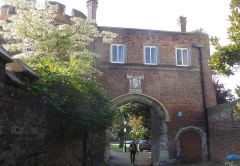
WE VISIT RICHMOND regularly to see a couple of friends, with whom we almost always take a stroll, usually somewhere reasonably near their home. They know that I love seeing places that I have never visited before and almost always they take us to see something that they feel might interest us. On our most recent walk with them, taken in October 2021, we began by walking across Richmond Green, taking a path that was new to us. At the western edge of the green, we crossed a road and immediately reached a Tudor gateway that leads into an open space surrounded by buildings. The open space is on the site of a now mostly demolished royal residence that was particularly liked by Queen Elizabeth I.
The royal residence was Richmond Palace. It was built by King Henry VII, when the 14th century Shene Palace, which used to stand on the site, was destroyed by fire in December 1497. Henry VII built a new palace on the same ground plan of Shene Palace. Richmond Palace, as the new building was named, was used continuously a royal residence until the execution of King Charles I in January 1649.
On a wall facing a pathway leading from the old gatehouse to the River Thames, there is a commemorative plaque with the following carved on it:
“On this site extending eastwards to cloisters of the ancient friary of Shene formerly stood the river frontage of the Royal Palace first occupied by Henry I in 1125…”
It adds that Edward III, Henry VII, and Elizabeth I all died in the palaces that stood on this riverside site in Richmond.
After Charles I lost his head, the palace, like many other parts of the royal estate, was sold by the Commonwealth Parliament led by Oliver Cromwell. Much of its masonry was sold. According to an informative source (www.richmond.gov.uk/media/6334/local_history_richmond_palace.pdf):
“While the brick buildings of the outer ranges survived, the stone buildings of the Chapel, Hall and Privy Lodgings were demolished and the stones sold off. By the restoration of Charles II in 1660, only the brick buildings and the Middle Gate were left.”
The same source relates that after being owned by the Duke of York, who became King James II, and after he was deposed:
“The remains of the palace were leased out to various people and, in the early years of the 18th century new houses replaced many of the crumbling brick buildings. ‘Tudor Place’ had been built in the open tennis court as early as the 1650s, but now ‘Trumpeters’ House’ was built in 1702-3 to replace the Middle Gate, followed by ‘Old Court House’ and ‘Wentworth House’ (originally a matching pair) in 1705-7. The Wardrobe building had been joined up to the Gate House in 1688-9 and its garden front was rebuilt about 1710. The front facing the court still shows Tudor brickwork as does the Gate House. ‘Maids of Honour Row’ replaced most of the range of buildings facing the Green in 1724-5 and most of the house now called ‘Old Palace’ was rebuilt about 1740.”
During our recent perambulation with our friends, we saw most of the buildings listed in the quote above but not the Maids of Honour Row. They also pointed out that Richmond Green, across which we walked, was used for jousting tournaments in mediaeval times. Today, this pleasant green space close to Richmond’s main shopping street is used for more peaceful purposes including walking, both human beings and their canine companions.
Once again, a visit to our friends in Richmond has resulted in opening our eyes to new places of great interest, and for that we are most grateful.


 yamey
yamey 