
Benjamin Franklin and Saint Bartholomew

ONE OF LONDON’S FEW remaining pre-1666 (Fire of London) buildings is the church of St Bartholomew the Great close to Smithfield Market. Founded in the 12th century, the building has many Norman (Romanesque) features. It also contains some contemporary artefacts including “Colloquy” (a work made from glass) by Sophie Arkette, and “St Bartholomew. Exquisite Pain” (a work in gilded bronze) by Damien Hirst.
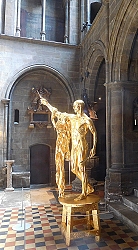
By Damien Hirst

Beyond the chancel at the east end of the church there is the spacious Lady Chapel. During the Reformation (after about 1529), this part of the church was closed off from the rest of it, and used as commercial premises. In the 18th century, it was used as a printer’s workshop owned by Mr Palmer. Benjamin Franklin (1706-1790), one of the founding fathers of the USA, worked as an apprentice in this printing works in 1725. Then, he was lodging nearby in Little Britain. While he was working in the converted Lady Chapel, he wrote his philosophical pamphlet, “A Dissertation on Liberty and Necessity, Pleasure and Pain.” Franklin wrote:

“At Palmer’s I was employed in composing for the second edition of Wollaston’s “Religion of Nature.” Some of his reasonings not appearing to me well founded, I wrote a little metaphysical piece in which I made remarks on them. It was entitled “A Dissertation on Liberty and Necessity, Pleasure and Pain.” I inscribed it to my friend Ralph; I printed a small number. It occasion’d my being more consider’d by Mr. Palmer as a young man of some ingenuity, tho’ he seriously expostulated with me upon the principles of my pamphlet, which to him appear’d abominable.”

The workshop was purchased by the church and restored as a Lady Chapel in 1897. An information panel next to it provides its history and connection with the young Franklin. It was by pure chance that I came across this London link with the American Revolution on the 4th of July.

Two similar churches, one in Kensington and the other in Wiltshire

ENNISMORE GARDENS MEWS IS about 380 yards west of Exhibition Road near South Kensington. It is the site of a church with an Italianate façade, now the Russian Orthodox Cathedral of the Dormition of the Mother of God and All Saints. A tall bell tower stands to the right of the façade as you look at it from the street. Pevsner described the style of the façade as “Lombardic Romanesque”. He noted:

“The Early Christian/Italian-Romanesque style was a speciality of the 1840s…”

Russian Orthodox church in Kensington, London

Although many of the fittings in the church are typical of Russian Orthodox places of worship (e.g., iconostasis and icons), the interior is not typical of edifices built specifically for the Orthodox church. The coloured panels above the arches (supported by iron pillars) lining the nave are not typical of the kinds of images usually associated with the Orthodox Church. They have captions in both English and Latin, but not in Cyrillic. The church was designed as the Anglican Church of All Saints in 1848-1849 by Lewis Vulliamy (1791-1871). The tower was constructed in 1871. Most of the decoration within the building is in the late 19th century Arts and Crafts style.

The Anglican parish, which was based in the former All Saints, merged with another in 1955. Then the church was let to the Russian Orthodox faith and its name changed to its present one. In 1978, the Sourozh Diocese purchased the edifice. The Sourozh is under the control of the Patriarchate of Moscow. The church in Ennismore Gardens Mews has a multi-national Orthodox congregation.  I asked a bearded priest how the cathedral differed from the Russian church in Harvard Road, Chiswick. He replied:

“We are the Orthodox Church based in Moscow, but the other one in Chiswick is the Orthodox Church based outside Russia … it is very complicated.”

Wilton in Wiltshire is almost 80 miles southwest of the Russian church in Ennismore Gardens Mews. Famed for its fine carpet manufacturing, the town has a church, St Mary and St Nicholas, whose façade looks not too different from that of South Kensington’s Russian Orthodox Cathedral. The Wilton church has a similar bell tower, but it placed on the left side of the façade. The church was commissioned by Sidney Herbert, 1st Baron Herbert of Lea (1810-1861), a close ally and supporter of Florence Nightingale of Crimean War fame. Sidney was a son of George Herbert, 11th Earl of Pembroke and his Russian spouse Catherine (née Yekaterina Semyonovna Vorontsova). The church, completed in 1845, was designed by Thomas Henry Wyatt (1807-1880) and his assistant David Brandon (1813-1897).

With many features borrowed from Italian Romanesque architecture, and some from Byzantine designs, the edifice at Wilton, despite being an Anglican parish church, felt to me slightly more like an Orthodox church than the converted ex-Anglican, now Orthodox, church in Ennismore Gardens Mews. However, the interior fittings in the church in Wilton borrow from what can be found in traditional Italian churches rather than in typical eastern Orthodox churches. But, the mosaic covered cupola over the chancel in Wilton’s Anglican church, with its depiction of Christ with two saints resembling what is often found in Byzantine churches, contrasts with the undecorated cupola over the chancel in what has now become the Russian Orthodox Cathedral in Kensington.

Placed side by side, many differences could be discerned between the church in south Kensington and that in Wilton. But it is the similarities between two churches designed by different architects that are remarkable.