THE JAL MAHAL (Water Palace) was constructed in about 1699. In the early 18th century, the lake next to it was enlarged, and the palace became partially submerged. Despite many attempts to clear the water from its lower storeys, the palace has remained partially submerged.
An autorickshaw driver told us that he believed that a djinn (supernatural spirit) resides in the Jal Mahal. Every time an attempt is made to drain the palace, four times as much water as has been removed comes back to flood the edifice.
Recently, an entrepreneur bought the palace, hoping to convert it into a luxury hotel. However, his attempts to dry it out have been a failure, and he has given up.
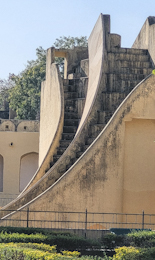
IT LOOKS LIKE MODERN sculpture at first sight. On closer examination, these fascinatingly shaped objects have carefully constructed scales, like the markings on a ruler or a protractor, attached to them. They are astronomical instruments that were constructed for the Rajput king Sawai Jai Singh (1688-1743), and they were completed by 1734. Together, they comprise Jaipur’s Jantar Mantar (literally ‘calculating instruments’). They were used to construct what has turned out to be extremely accurate astronomical tables.
Sawai Jai Singh was very interested in mathematics, astrology, astronomy, architecture, and literature. He studied scientific works by, for example, Ptolemy, Newton, Flamstead, and Euclid. He had Euclid’s “Elements of Geometry” translated into Sanskrit. His interest in astronomy might have been inspired in1702 by his tutor Jagannatha Samrat.
The Jantar Mantar in Jaipur contains 18 separate stone instruments with metal attachments . My knowledge of astronomy is minimal. So, I will not try to explain for what purpose each was, and still can be, used. A Wikipedia page (https://en.m.wikipedia.org/wiki/Jantar_Mantar,_Jaipur) can help with explaining their purposes.
To a visitor, like me, who is unversed in astronomy, and to those who are familiar with modern astronomical instruments, the Jantar Mantar presents the visitor with one of the most extraordinary looking tourist sights that India has to offer. It is not unique. In addition to the one in Jaipur, Sawai Jai Singh built four others in northern India. However, the one at Jaipur is the largest and best preserved.
If one did not know its purpose, the Jantar Mantar observatory compound would seem as if it is one of the world’s most superb sculpture parks.
THE RAJ MANDIR cinema was completed in 1976. It was designed in the Streamline Moderne ( or late Art Deco) style by WM Namjoshi for Kushalchand Surana. It was conceived by Mehtab Chandra Golcha. According to Wikipedia, it is the largest single screen theatre in Asia.
We went to see a film called “Pushpa part 2”. It was made in the Telugu language and dubbed into Hindi. It is about sandalwood smuggling and corruption. Despite not being able to follow much of the dialogue,it was extremely exciting and beautifully filmed. It was so dramatic that we left the cinema feeing exhausted.
The cinema is spectacular visually. One enters from the street into a huge, circular foyer decorated in an opulent fashion. The auditorium is spacious and, like the foyer, spectacularly decorated. The screen is curved, and the surround sound system very good.
Even if one cannot follow a film because it is in a language that you do not know, a screening at this cinema is an experience not to be missed in Jaipur.
WHEN TRAVELLING IN RAJASTHAN it is not unusual to see single-humped camels (dromedaries). Often, they are hitched to wagons, both loaded and unloaded. They can haul loads of several times their body weight, which in adults can range from 400 to over 600 Kilograms. They can also be used to pull ploughs.
Unlike wheeled vehicles, camels are extremely agile on the roughest of terrains. They are often employed in off-road tasks. And they differ from other beasts of burden by being able to function well in high ambient temperatures. For example, they can survive without drinking for longer than other creatures. Also, their feet are adapted to be able to endure the extremely high temperatures that the ground can reach when it is heated by the sun. I first became aware of this when my PhD supervisor, Robert Harkness, described the research he had done on the connective tissue of the pads within camel’s feet. He had first become interested in this when he spent some time teaching at a university in Kuwait.
During our visit to Rajasthan and also on earlier visits to various parts of Gujarat, we have often spotted camels, both working and grazing. To someone like me, who grew up in Western Europe, seeing camels, which are not in a zoo, is an exciting experience.
Finally, I cannot resist repeating an old joke I learned when I was a child. In those days, there was an airline called British Overseas Airways Corporation, BOAC for short. Some witty friend of my parents told me that BOAC really stood for: “Better On A Camel”.
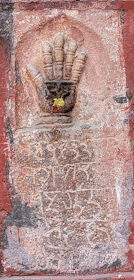
ON THE WALL NEXT to one of the several gates, the Daulat Prole, that leads into the Junagarh Fort in Bikaner, you can see a set of what look like the impressions made by pressing hands into a soft material. Each of these hand prints is labelled in Hindi (Devanagari) lettering. These impressions are amongst the last actions of widows about to commit sati.
Sati was the usually forced self-immolation of widows. Sati was the tradition in India that involved widows being forced to throw themselves on their husband’s burning funeral pyre. Sometimes, they did it apparently voluntarily. It was a tradition often practised by Rajputs, but not restricted to them. During the British occupation of India, there were various attempts to outlaw sati, but incidences of it continued into the 20th century. Finally, in 1987, the Government of India passed an Act criminalising the practice of sati and its glorification.
Returning to the hands at the Junagarh Fort, one of the officials guides told us the following. Prior to being caste onto her spouse’s funeral pyre, the noble Rajput widow would dress in her finest clothes and jewellery, and approach the Daulat gate. By this time, her hands would have been covered with henna (mehndi). She would then press the palm and digits of her right hand on a stone slab, leaving a print of her hand on it. Later, an artisan carefully carved a three-dimensional impression of the widow’s hand. By that time, the poor woman had been incinerated.
In Rajasthan, various of the Princely States abolished sati in the first half of the 19th century. In Bikaner, the last Maharani to die on her husband’s pyre was in about 1825, so we were told by the guide at the fort.
My eye was immediately attracted to the sati memorials. I wonder how many other visitors to the Junagarh Fort stop and contemplate these tragic memorials before proceeding with taking photographs of each other at the many picturesque spots within the fort.
UNLIKE JAIPUR, JODHPUR, and Jaisalmer, the city of Bikaner in Rajasthan is not (yet) overrun with tourists. We have been in Bikaner for three days and apart from at the Junagarh Fort (Bikaner’s most significant historical attraction), we have seen only one European visitor. Bikaner differs from the three Rajasthani cities mentioned in the first sentence in that its streets are not lined with shops designed to attract tourists. Apart from the fort the rest of the city is a fascinating, busy working environment, which someone, like me, who enjoys observing everyday scenes of life in India, has plenty to see.
Many of the older buildings that can be seen in the streets of Bikaner have jharokas – decorative, stone-framed windows that project over the street. They are commonly seen features of the Rajput style of architecture and are still being constructed.
The Junagarh Fort is rich in jharokas. Many of them overlook courtyards within it. One of them is of great interest. From a distance it looked to me like it was decorated with blue and white tiling, like Portuguese azulejo work. Close up, it can be seen to be something else.
A huge consignment of Dutch blue and white Delft ceramic plates had been ordered for the royal family of Bikaner. When that was, I do not know. While they were being transported to India by sea, they were damaged, and arrived broken. Instead of throwing them away, the thrifty maharajah had them cut up to produce tiles, all of which bore details from the pictures that had decorated the plates. The tiles were then used to decorate both the inside and the outside of the jharoka overlooking a courtyard that contains an elaborate water feature: a pool with fountains.
Although there is much more to be seen in the fort, this example of repurposing broken plates intrigued me. The Junagarh Fort is definitely a must-see attraction in Bikaner, but it it is now merely a museum-like remnant of the past. Visitors to the city should see this, but also set aside at least a few hours to absorb the busy atmosphere of enterprise, both traditional and contemporary, in the older districts of Bikaner.
GHEVRA IS A Rajasthani food preparation containing ghee, maida (refined flour), milk, and sugar syrup. This mixture is poured into a (usually) circular metal mould and heated vigprously until it attains a texture like honeycomb. Various sweet toppings can be put on the finished Ghevra. We sampled a piece topped with rabri (a sweet made by boiling down milk slowly).
THE OLD FORT of Bikaner dominates the centre of the bustling city of Bikaner in Rajasthan. Visitors can view rooms and halls within the fort by joining a guided tour. The tour we joined was led by an intelligent, informative man. The architecture of the fort and much of its interior decorations are spectacular. Amongst the many exhibits we saw were some relating to Maharaja Ganga Singh (1880-1943), who was ruler of Bikaner from 1888 until his death.
The Maharaja’s full title was General Maharaja Sir Ganga Singh, which reflects his role during two world wars. During WW1, he commanded the Bikaner Camel Corps, which served in France, Egypt, and Palestine. Before that, he served in China during the suppression of the Boxer Rebellion. During WW1, he was appointed a member of the Imperial War Cabinet. Because of this, he was present at the signing of the Treaty of Versailles in 1919. He was the only Indian signatory, the only non-European, at this momentous occasion. Later, he represented India at the League of Nations. In addition to his military achievements, Ganga Singh did much to improve the living conditions and economy of his state.
The Maharaja’s soup spoon
Within the fort there are many memorabilia connected with Ganga Singh. The most intriguing of these is a silver spoon designed so that the Maharaja could eat soup without it touching his impressive moustache. The bowl of the spoon has a barrier that would have kept the moustache pushed away from the soup in its bowl.
Among many other souvenirs of Ganga Singh is a De Haviland DH-9E aeroplane. This was one that had been shot down during WW1, and given to Ganga Singh in recognition of Bikaner State’s services during the war. It was restored by Maharaja Karni Singh in about 1985, and is now housed in one of the fort’s huge assembly halls.
I have described two of the things that amazed me during my visit to the fort. I plan to describe more soon.
IT IS NOT UNUSUAL to find a swing (‘hichko’ in Hindi) in an Indian home. Often, they consist of a seat suspended from a frame by ropes or chains. The museum in the fort at Jodhpur in Rajasthan has a fine collection of hichkos that were once used by the former royal family.
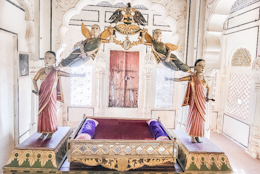
Hichko presented by the PWD
One of the swings in the collection caught my eye both because it was quite different in design from the others in the collection and because it bore an interesting label, which had been attached by its maker(s). The wording on the label reads:
“With profound loyalty of Jodhpur PWD Employees Union”
(PWD: Public Works Department)
This hichko which is decorated with the royal crest of Jodhpur and almost lifesize models depicting two women in saris is not dated. The union still exists, but since 1947, the royal family has lost the power which it once possessed.
THE WALLS OF THE fort in Jaisalmer (Rajasthan) contain a living city that has been in existence since the early 18th century, but the fort itself was established in the 12th century. It is enjoyable to wander the narrow lanes that thread their way between houses, many of which are decorated with elaborate, Rajput style carving.
The only thing that can cause the visitor some concern is the regular passage of motorbikes and scooters along the thoroughfares which are severely limited in width. These vehicles, often driven by impatient people who sound the horn loudly and frequently, squeeze past one, narrowly avoiding injuring pedestrians. I suspect that these motorists find the tourists as irritating as the pedestrians regard them. That said, like Venice, whose main thoroughfares are crammed with visitors, Jaisalmer, like Venice, has byways that are almost deserted apart from the few residents who dwell in the houses lining them.
A tulsi tree
Today, we made a second visit to the fort and tried to avoid the busiest lanes as much as possible. In so doing, we stumbled across two lovely old mandirs (Hindu temples). Both were constructed in the 15th century, long before the fort became a residential area for civilians.
Both mandirs are still used for worship. In one of them, the Laxmi Narayan mandir, two pandits (priests) were having a heated argument yelling at each other across the courtyard. At this mandir, there was a tulsi (holy basil) tree, growing in a container, which has small alcoves in which lighted diyas (oil lamps) can be placed. I watched a man walking clockwise around the tulsi tree several times. When he had done this, he plucked one of its leaves and touched it reverently against his forehead.
The tulsi tree is of religious significance to devout Hindus. I read somewhere that when the Portuguese were occupying Goa and trying to encourage people to become Roman Catholic, tulsi trees were outlawed in that former colony.
The courtyard of the Laxmi Narayan was partly shaded by a peepal tree, whose leaves are heart shaped. Like the tulsi tree, the much larger peepal tree is also of religious significance.
The other old temple, which is smaller than it’s neighbour (Laxmi Narayan), is called the Ratneshwar Mahadev. I did not notice any tulsi plants associated with it. However, a peepal was growing next to it.
Although both mandirs had visitors, both locals and tourists, they were less crowded than the much-visited Jain temple with the fort. When we walked past it yesterday, it was literally swarming with tourists.
Apart from the spectacular array of finely decorated buildings that can be seen, what makes the fort of Jaisalmer well worth seeing is that it is still home people who live their everyday domestic lives there. Interspersed amongst the many things designed to appeal to tourists, one catches frequent glimpses of local people living their daily lives.







 yamey
yamey 