
AS A YOUNG CHILD, maps fascinated me, and they continue to do so. When peering at maps of England during my childhood, the name Worksop caught my attention. I cannot imagine why this name interested me, but it did.
Until 1 May 2026, I had never visited Worksop. As we were not too far from this town in the northwest of Nottinghamshire, we decided to drive through it so that I could ‘put a face’ to the name that has been in my mind for many decades.
The name Worksop is derived from an Old-English name ‘Weorc’ and ‘hop’ meaning valley. Prior to visiting the place, I assumed that the town would be unattractive and devoid of interest. How wrong I was.
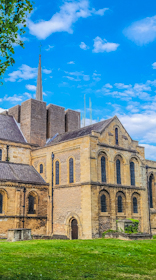
During our short sojourn in Worksop, we stopped at the Priory Church of Saint Mary and Saint Cuthbert. This Anglican parish church is usually known as ‘Worksop Priory’. The Priory was established by the Augustinians in 1103, and dissolved during the reign of King Henry VIII. Much restored, the church has a modern spire above the crossing, which was rebuilt in a modern style in the 1970s, and designed by the architect Laurence King. The church stands near the to a pleasant park in which the Priory’s mediaeval gatehouse can be found.
Time did not allow us to explore the rest of Worksop, but if the Priory is anything to go by, another visit to the town might prove interesting.
 yamey
yamey 