This is the tower of the 15th century St Peter Mancroft in Norwich, Norfolk. Situated next to the market place, this is the city’s parish church. It is the centre of civic worship, whereas the magnificent cathedral is the ecclesiastical centre of the city’s worship. Both this church and the cathedral make a visit to Norwich worthwhile. The city has other magnificent attractions, which I will write about soon.
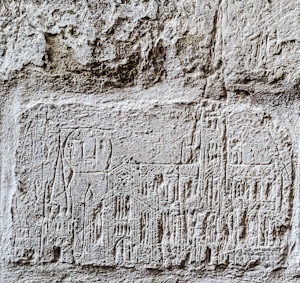
I HAVE WRITTEN ABOUT this before, but because I found it so interesting I will write about it again. In August 2024, we revisited the picturesque village of Ashwell in Hertfordshire on our way between London and Cambridge. Apart from being an extremely attractive place, its parish church of St Mary ccontains an intriguing image scratched into the internal surface of the north wall of the bell tower.
The image is a drawing of London’s old St Paul’s Cathedral, which was destroyed during the Great Fire of London (1666). By comparing this picture with other pre-1666 drawings of the old cathedral, it can be seen to be an accurate depiction of the long since destroyed edifice. It is likely that the drawing in Ashwell was scratched into the wall sometime before 1930s, when the old cathedral was modified by Inigo Jones.
Above the image of the old cathedral, there are some inscriptions recoding plagues that occurred during the 14th century, including what is known as the Black Death.
Apart from the drawing and the inscriptions described above, the church contains a few other inscriptions, which have been partially deciphered.
For the information of those visiting the church, it is near to Day’s bakery, where delicious snacks can be purchased. The village also contains a small museum, part of which is housed in a half-timbered building. However, for me, the highlight of the village is the drawing of old St Paul’s Cathedral in the church.
A TRAGEDY OCCURRED on the 19th of September 1963. Aged 21, Sara Venetia d’Avigdor Goldsmid lost her life in a sailing accident. She was the daughter of Major Sir Henry Joseph d’Avigdor-Goldsmid, (1909-1976) of the Jewish faith and his wife Lady Rosemary d’Avigdor Goldsmid, an Anglican. The family lived at Somerhill, a Jacobean mansion (now a school) near to the church of All Saints at Tudely (just under 2 miles east of Tonbridge). Lady Goldsmid and her daughter Sara used to worship in this small church, which dates to mediaeval times, if not before. Much of the existing structure was constructed in the 13th and 14th centuries, but it was heavily restored in the 18th century.
After Sara’s death, her parents wanted to do something to perpetuate her memory. They and others decided to restore the church. Part of this operation was to replace the existing plain glass east window with a commemorative window, which they asked the artist Marc Chagall (1887-1985) to design for them. This Jewish artist was chosen because Sara and her mother had admired Chagall’s stained-glass at an exhibition they had visited at the Louvre in Paris (France). These included some of the windows that Chagall had created for the synagogue of the Hadassah Medical Centre in Jerusalem (Israel). They were installed in 1962 after having been exhibited not only in Paris but also in New York City.
Chagall created the drawings for the windows, and they were translated into stained-glass by Charles Marq (1923-2006) of Rheims (France). When Chagall visited Tudely, and saw his window after it was installed and dedicated in December 1967, he was so satisfied with it that he offered to create stained-glass images for all the other windows in the church. His offer was accepted. He managed to complete this work, but it was some years before the congregation at Tudely finally agreed to replace the existing Victorian stained-glass windows in the church with those created by Chagall. It was only some time after the church warden, Kenneth Stinton, had seen the Chagall windows on display at the Royal Academy of Arts in Piccadilly in 1985 that the idea of replacing the Victorian windows with Chagall’s became acceptable. They were placed in the church by December 1985.
Many of Chagall’s windows at Tudely are rich in dark blue colouring. Entering the church and finding it suffused with predominantly blue light is like entering an underwater space. This might be intentional as poor Sara d’Avigdor Goldsmid’s life ended beneath the water of the coast near Rye (Sussex). If she saw anything at all as she sunk beneath the sea, it might well have been such a dark blue light. I have visited Tudely’s church several times, and each time the same thought occurs to me. My first visit must have been in the 1980s after December 1985, because I have never seen the church without all the Chagall windows installed.
The church is in a rural setting, surrounded by fields. It has become a tourist attraction, and is occasionally used to hold chamber music concerts, one of which I attended in the early 1990s when I was still practising dentistry in north Kent. Although a little remote, this gem of a church is well worth making an effort to visit it.
I HAVE PASSED IT OFTEN while travelling along London’s busy Marylebone Road and admired its elegant neoclassical portico supported by six columns with Corinthian capitals, but never entered it until today (the 7th of September 2022). I am referring to the Church of St Marylebone, consecrated in 1817. One of its predecessors, dedicated to the Blessed Virgin Mary was erected nearby in about 1400. It stood near the River Tyburn. The name Marylebone seems to be derived from a conjunction of the words Mary and ‘burn’ (from Tyburn, which began to have a bad reputation because of the much-used gallows close to its banks). This early church was replaced by another, constructed in 1740. It survived until it was demolished in 1949. Nearby, the present larger church, which we see today, was constructed in 1817 on what was then the New Road, a by-pass on the northern edge London, and is now Marylebone Road. Its grand portico faces north, and the high altar and the colourfully decorated apse are in the south end of the building. The church, a typical example of a Regency interior with first-floor galleries, is tall and spacious.
Charles Dicken’s son was baptised in the church. The poet Robert Browning (1812-1889) married a fellow poet Elizabeth Barrett (1806-1861) in the church in 1846. And the composer John Stainer (1840-1901) composed his oratorio “The Crucifixion” specially for this church in 1887 when he was already a fellow of the Royal Academy of Music, which is across the main road facing the church.
The Methodist Charles Wesley (1707-1788), who lived nearby, asked to be buried in what was the churchyard of the older (1740) church. Where this edifice stood is now a peaceful open space, the Garden of Rest, next to Marylebone Lane (a few feet south of Marylebone Gardens). In this small space, there is a stone obelisk mounted on a pedestal. This commemorates the life of Charles Wesley and several members of his family.
Close to Madame Tussauds and the Royal Academy of Music and neighbouring one of London’s more enjoyable shopping areas – Marylebone High Street, stands the lovely church of St Marylebone, which as I discovered today, merits a visit.




 yamey
yamey 