
THE BARBICAN ART Gallery is holding an exhibition, “Project a Black Planet”, until 6 September 2026. Filled with a variety of superb artworks by a range of artists, it is well worth seeing. It also includes artistic videos, photographs and documentary material,
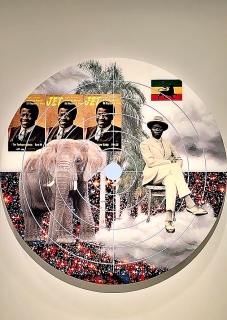
The exhibition’s theme is the art of Pan-Africanism. The gallery’s website describes Pan-Africanism as:
“… a broad spectrum of political and philosophical movements advocating anti-colonial resistance and transnational solidarity amongst peoples of African descent.”
Wikipedia has an article on Pan-Africanism, which noted:
“As a philosophy, Pan-Africanism represents the aggregation of the historical, cultural, spiritual, artistic, scientific, and philosophical legacies of Africans from past times to the present. Pan-Africanism as an ethical system traces its origins from ancient times, and promotes values that are the product of the African civilisations and the struggles against slavery, racism, colonialism, and neocolonialism … Modern Pan-Africanism began around the start of the 20th century. The African Association, later renamed the Pan-African Association, was established around 1897 by Henry Sylvester Williams, who organized the First Pan-African Conference in London in 1900 … Pan-Africanism is a movement that aims to encourage and strengthen bonds of solidarity between all indigenous peoples of Africa along with all peoples of African descent. The belief extends beyond continental Africans with a substantial support base among the African diaspora in the Americas and Europe.”
The works on display illustrate the ideas and realities of this movement well in a variety of visually intriguing ways.
The artists whose works are being shown come from Africa, Brazil, the Caribbean, North America and Western Europe. Some, such as Chris Ofili, Marlene Dumas, El Anatsui, William Kentridge, Wilfredo Lam, Ibrahim El-Salahi, Lubaina Himid, and Lynette Yiadom-Boakye are artists whose works I have seen before. The other artists were new to me, but most of their works are highly accomplished and visually fascinating. Oddly, the well-known artists Yinka Shonibare and Hurvin Anderson were not represented.
The exhibits were wonderfully displayed in the well-designed Barbican Gallery, which I feel is a better place to display modern art than the Tate Modern. Each of the rooms on the first floor were dedicated to artworks relating to some of the many aspects of Pan-Africanism, and in each space, there was an information panel explaining how the artworks fitted into the Pan-African scheme of things. Even without the explanations, what was on display at this show is a satisfying feast for the eyes.

