
VASCO DA GAMA and his Portuguese crew set foot on Indian soil near Calicut in Kerala in 1498. The Portuguese were not the first Europeans to arrive in India: Romans had traded with India long before the fifteenth century, but there are no known remains of any structures they might have built. Despite the lack of any structures known to have been built by the Ancient Romans, many Roman coins have been found in India.
In 1503, five years after Vasco arrived, some Portuguese sailors erected a wooden fortress at Pallipuram, about 18 miles north of the present Fort Kochi and 100 miles south of Calicut. Two years later this fort was replaced by a hexagonal stone structure. This two-storey edifice is believed to be India’s oldest existing building built by Europeans.
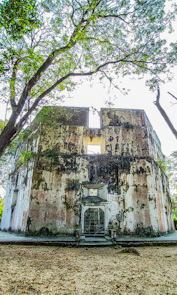
The upper storey of the fort, on which would have been placed canons, no longer exists. Each of the fort’s six walls are about 6 feet thick, 32 feet wide, and 34 feet tall. They contain 18 former embrasures for cannon.
A staircase leads from the ground to the ground floor of the fort. Next to this, there is a circular plaque with the words: “Pallipuram Fort. The most ancient European building in India. About 1503. Conserved as a historic relic by the Government of Travancore. AD 1909”.
The fort remained in Portuguese hands until 1661, when it was captured by the Dutch. Then the Dutch sold it to the Kingdom of Travancore in 1789. It remained under the control of Travancore until India became independent in 1947.
Today, although little remains to be seen apart from the hexagonal walls, it is fascinatingly evocative to visit a place with such an interesting history. Located within its peaceful grounds there is a square pond (tank) filled with water. I have no idea how long that water feature has been in existence.
Standing looking it in the hot humid heat on a January afternoon, I wondered how the sixteenth century Portuguese managed to bear the uncomfortable climate and survive in this fort that was once surrounded by steamy jungle.
 yamey
yamey 