
ONCE AGAIN, OLSI QINAMI has conducted the London City Philharmonic Orchestra superbly. Last night (the 28th of October 2023), they performed Rachmaninov’s Piano Concerto number 2 and Stravinsky’s “The Rite of Spring” in the Victorian gothic St James church at the Lancaster Gate end of Sussex Gardens.
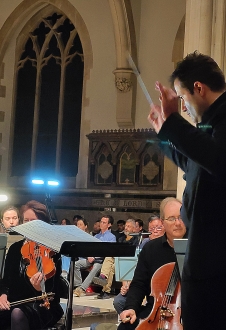
Olsi Qinami was born in Albania. At the age of six, he began studying the piano. Then, he studied in Tirana’s Lycée Artistique “Jordan Misja”. Later, he studied at London’s Royal College of Music and also at both the Royal Birmingham Conservatoire and the Ecole Normale de Musique de Paris. A website with his biography (www.olsiqinami.com) noted:
“Olsi continued his studies with Paavo Jarvi at the “Jarvi Conducting Academy”, Riccardo Muti at the “Riccardo Muti Opera Academy” with Orchestra Giovanile Luigi Cherubini, “Orkney Advanced Conducting Course” with Alexander Vedernikov & Charles Peebles and “the Royal Northern College of Music Advanced Conducting Masterclasses” with Mark Heron. He also studied with, Jorma Panula, Michalis Economou, Marco Guidarini, Stefano Ranzani, Alexander Vedernikov, Daniele Rossina, Roland Çene, Petrika Afezolli, Bujar Llapaj, Howard Williams, Neil Thomson and others.”
This impressive education has certainly paid off, as we experienced last night at the concert.
Both works were played superbly. The piano soloist Angela Szu-Hsuan Wu played what seemed like a technically challenging piece by Rachmaninov with great verve and skill, and deserved the tumultuous applause that followed the performance. After a short interval, the orchestra increased in size, getting ready to tackle “The Rite of Spring”. Olsi mounted the conductor’s stand to face an enormous orchestra. Before commencing the performance, he said a few words about the many challenges that Stravinsky’s work poses the orchestra playing it. For example, he explained that within the approximately 40 minutes that the “Rite” takes to perform, there are well over 400 changes of time signature (measures of rhythm). Then, he asked a horn player to play various versions of a tune that Stravinsky had composed in various versions of his work. After that, the orchestra performed the great work. It was an exhilarating performance. Under Olsi’s direction, the orchestra had the audience spellbound. In such a complex piece of music, so much could have gone wrong, but in Olsi’s hands nothing did.
Listening to music played ‘live’ is so much more satisfying than even the best quality recorded music. The three-dimensional spatial appreciation of the sound in a concert hall, or in the case of last night, in a church, can barely be reproduced with the best of hi-fi equipment. As with live theatre, when attending live music, the audience is somehow intimately engaged with the energy and enthusiasm of the players. After a great performance, such as last night’s concert, I am left feeling both exhausted and exhilarated. Last night’s concert performed by the London City Philharmonic orchestra with Olsi Qinami was no exception to this. If you have not yet experienced Olsi conducting, then it is high time that you get to one of his concerts.

 yamey
yamey 