
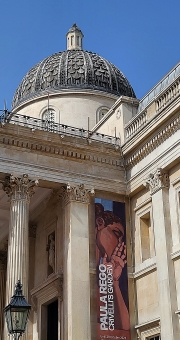
THE SAINSBURY WING of London’s National Gallery is stark, almost clinical, compared with the older nineteenth century rooms in the rest of the place. Although the pictures in the new wing can be seen without the eye being distracted by the rooms’ decorative features, I found that the paintings felt more ‘at home’ in the older, highly decorated galleries. One of these rooms, Room 36 has a central octagon topped by circular, glazed dome. In contrast to the Sainsbury Wing, this octagonal and the rooms leading of it, the Barry Rooms, are gloriously decorative in a Victorian baroque style. This and the rooms adjoining it were designed by the architect Edward Middleton Barry (1830-1880). His creations in London include The Royal Opera House and the Charing Cross Hotel.
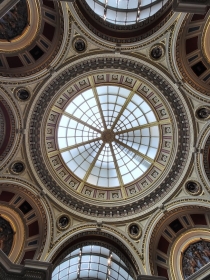
There are several paintings by great artists such as Claude and Turner in the octagon. If you avert your eyes from these masterpieces, you might notice a small commemorative plaque that reads:
“Dame Myra Hess. On 10 th October 1939 in this room the pianist Myra Hess performed the first of many music concerts for the enjoyment of Londoners during wartime”.
Myra Hess, who was born in South Hampstead in 1890, died in London in 1965. She studied music at the Guildhall School of Music and at the Royal Academy of Music. Her concert debut was in 1907. During WW2 when most concert halls were out of action, she organised almost 2000 lunchtime concerts in the National Gallery: Monday to Friday for six years. She played in 150 of them, and never took a fee for her playing. In recognition of her work in keeping up the morale of those who heard her, King George VI made her a Dame Commander of the Order of the British Empire in 1941.
At the time of her death in 1965, Myra Hess was residing at 48 Wildwood Road in Hampstead Garden Suburb. Although I lived not far from her in the Suburb during my childhood, then I was unaware of both her existence and the fact that she was almost a neighbour. It was only during the twenty-first century that I spotted her creeper covered commemorative plaque on the house in Wildwood Road. Although I am glad that I did not have to live through WW2, I would have enjoyed listening to a concert in the gloriously decorative octagonal room at the National Gallery.



 yamey
yamey 