Marilyn, Mao, and more at Milton Keynes

ONCE AGAIN, THE MK Gallery at Milton Keynes has put on a superb exhibition. Until 29 June 2025, there is a show of artworks by the artist and film maker Andy Warhol (1928-1987), who was born in the USA. Best known for his multiple portraits of figures such as Marilyn Monroe and Mao Tse Tung and Pop Art images, there is much more than this on display at the MK.

The first room of the show contains work that Warhol created in the 1950s and early 1960s. Like artists such as Picasso and Hockney, whose creative lives began with works that were not as experimental and novel as their later works, Warhol’s earlier, less revolutionary, images show that he was a competent draughtsman capable of producing highly acceptable ‘straightforward’ compositions. It was interesting to see his earlier works because they are rarely displayed in public galleries. And it is always nice to see how an artist who is best known for his or her more extraordinary creations began his or her creative output.

The exhibition includes many of Warhol’s Pop Art images including those of Marilyn and Mao, but also there are several of his portraits of other figures. These include the artist Basquiat, the politician Barry Goldwater, Marcel Duchamp, Joseph Beuys, Muhammad Ali, and Liz Taylor. What I found interesting was that amongst the portraits on display, there were a few of the British artistic couple Gilbert and George. As the exhibition booklet related:

“The British artistic duo Gilbert and George , like Warhol, explored the interplay between personal and public identity, often blurring the lines between performance and art.”

Warhol’s portraits of this couple reflect their own graphic artistic style.

Other images on display relate to the Cold War and to the electric chair. The images on display in the show include drawings, prints, posters, and photographs (often adjusted to create interesting artistic effects). There are also exhibits relating to Warhol’s prolific output of films. He made about 600 of them. It would have been interesting to have been able to see extracts from some of them.

In brief, this is an exhibition that is worth travelling to. Apart from being beautifully displayed alongside helpful information panels, it is worthy of a visit to be able to enjoy seeing this artist’s rarely seen early works.

Cross cultural fertilisation between India and Europe at Milton Keynes

THE ARTIST REMBRANDT (1606-1669) produced a set of 23 drawings based on Mughal miniature paintings that were created in India in the early 1600s. In her article (see: https://mapacademy.io/what-rembrandt-learned-from-mughal-miniatures/), Shrey Maurya wrote:

“Perhaps the original Mughal miniatures arrived from the Dutch trading post in India. It’s also possible that he encountered the paintings in the collections of wealthy traders and various Dutch East India Company officials, who were his friends and often his clients.”

Shrey added:

“These drawings are remarkable for they allow us to understand the incredible global network established by trade ships which allowed an exchange of cultures to take place on a global scale.”

Recently, we visited an excellent exhibition at the MK Gallery in Milton Keynes: “Beyond the Page. South Asian Miniatures and Britain 1600 to now.” Amongst the many beautiful and intriguing exhibits, there were a few that illustrated the influence of Mughal painting on Western European artists. Although none of the above-mentioned Rembrandt drawings were on display, what I saw interested me greatly. I have been long aware of the influence of western artistic trends on the works of artists from the Subcontinent, but not the other way around.

An artist, Willem Schellinks (1623-1678), one of Rembrandt’s contemporaries is represented in the MK Gallery’s exhibition. He, like Rembrandt, is believed to have studied an album of Mughal paintings, which was thought to have been in the possession of the English art collector Alethea Howard (1585-1654), Countess of Arundel, who lived in Amsterdam from 1641 until her death. Incidentally, her portrait was painted by Peter Paul Rubens (1577-1640). In addition to sketches, Schellinks is known to have painted at least six paintings that contain Indian imagery (see the detail above). One of these and a sketch are on display at the MK Gallery.

In the same room as the Schellincks works, there is a painting by William Rothenstein (1872-1945). Drawing inspiration from traditional Mughal miniature paintings in the India Office Collection (in London), he created his “Sir Thomas Roe’s embassy to the court of Jahangir”, which was completed in 1924.

Before seeing the exhibition at Milton Keynes, I knew that Rothenstein had an interest in Indian culture. For example, he helped Rabindranath Tagore (1861-1941) to find accommodation in Hampstead’s Vale of Health in 1911-1912, but the well-produced exhibition catalogue provided me with information that was new to me. For example, Rothenstein had visited India and was a collector of Rajput paintings and drawings. In addition, in 1910 he was a co-founder of the India Society of London, whose aim was to bring Indian Art, in its many forms, to the attention of audiences in Britain and the world. So, it is maybe unsurprising that he chose to paint his picture of Sir Thomas Roe (c1581-1644) meeting with Emperor Jahangir (1569-1627) in a style that was influenced by the painters who would have around at the time of that historic rendezvous, sometime between 1616 and 1619.

Close to Rothenstein’s painting, there is an image by Abanindranath Tagore (1871-1951), who was a nephew of Rabindranath Tagore. This chromolithograph, “The Last Moments of Shah Jahan”, was created in 1903 in the style of traditional Mughal miniature painting. It is interesting to note that Abanindranath had never encountered Mughal paintings until he was in his twenties. He was introduced to them by another of the founders of the India Society, the art historian Ernest Binfield Havell (1861-1934). Havell had served the Madras School of Art as Superintendent for a decade from 1884, and in 1896 became Superintendent of the the Government School of Art in Calcutta. According to Wikipedia:

“Havell worked with Abanindranath Tagore to redefine Indian art education. He established the Indian Society of Oriental Art, which sought to adapt British art education in India so as to reject the previous emphasis placed on European traditions in favour of revivals of native Indian styles of art, in particular the Mughal miniature tradition.”

The works by Schellincks, Rothenstein, and Abinindranath Tagore, all on display at the MK Gallery, vividly demonstrate the cross-cultural fertilization that began when Europeans first set foot on Indian soil with intentions that were far from being cultural.  I have written about only a few of the wonderful exhibits in the show, but all of the others on display are not only beautiful but are filled with a wide variety of deep meanings. Of the many exhibitions I have seen this year, the one showing at the MK Gallery until the 28th of January 2024 is by far the best.

An old Mughal painting in an altered format

THE PADSHAHNAMA WAS created by Abdul Hamid Lahori (and others) and completed in between 1630 and 1637. It is an illustrated history of the reign of the Mughal Emperor Shah Jahan I (1592-1666). In 1799, a copy of this valuable manuscript was sent by Saadat Ali Khan II, the Nawab of Awadh as a gift to the British King George III. This edition has been preserved in the Royal Library at Windsor. It contains 44 intricately painted Mughal miniatures. In 1997, reproductions of the paintings in this version of the Padshahnama were published in a catalogue produced to accompany the precious book as it travelled the world in an international touring exhibition. As with many publications, the illustrations in it are subject to copyright.

One of the paintings in the Windsor Padshahnama depicts the arrival of the gifts for Nadira Banu, the bride of Shah Jehan’s son, the ill-fated Dara Shikoh. They married in 1632, a year after Shah Jehan’s wife – Mumtaz Mahal – died.  The Taj Mahal was built in her honour. This painting has been lent by the Royal Collection to be displayed in a brilliant exhibition, “Beyond the Page – South Asian Miniatures and Britain, 1600 to Now”, which is being held at the M K Gallery in Milton Keynes until the 28th of January 2024. This lovely painting hangs in the first of the gallery’s five rooms.

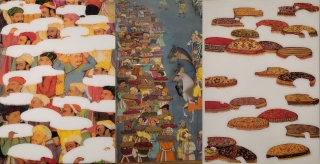
In another room, the viewer will encounter a work by Hamra Abbas (born 1976 in Kuwait). Her artwork consists of four panels. The two central panels are enlarged copies of two pages of the catalogue of the above-mentioned exhibition. One of them is the title page of the catalogue, and to its left is the “all rights reserved” page, which warns the reader that no part of the publication may be reproduced in any way at all.  These two pages are flanked by two images (illegally) reproduced from the images of the original miniature in the catalogue, and then modified.

Ms Abbas has reproduced the part of the page in the Padshanahma which depicts the crowd of men bearing the bridegroom’s gifts to his bride. To the left of the two middle panels, we see the image of these bearers, but the gifts they were carrying have been removed from the image, leaving white spaces with the outlines of the shapes of the gifts, On the right side of the middle panels, we see the depictions of the removed gifts arranged against a white background. The artist has named this work “All Rights Reserved”. She devised it in 2004. By removing the gifts from the bearers, the artist has made her own interpretation of the removal of the Padshahnama from India in 1799.

The Padshahnama was not the only gift that Saadat Ali Khan II gave the British. He was crowned in 1798 by the British Governor General of Bengal, Sir John Shore. In gratitude, he ceded half of the Awadh (Oudh) kingdom to the British. Now that colonialism is being examined critically (at last), Ms Abbas’s intriguing artwork makes a subtle but powerful statement.