
A resourceful lady and a book about a famous Turkish architect in Istanbul

THE ARCHITECT MIMAR SINAN (c1489-1588) was the greatest of Turkish architects. There are many wonderful buildings of all sizes and for a wide variety of purposes designed by him all over Istanbul.
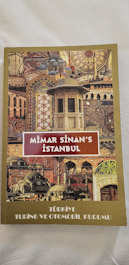
When visiting a tourist information office on the Asian side of Istanbul, I noticed several copies of a book called “Mimar Sinan’s Istanbul”. Beautifully illustrated with a detailed text, I quickly decided that I would love to own a copy. I asked if I could buy a copy. The official said that he could not sell me one because they were for reference only. I asked where they were sold, and was told that I could buy one at the publisher’s bookshop. The book is published by Turing. The discovery of the book occurred on a Friday.

On the following Sunday, we found the Turing shop. It was shut. We went again on Monday, and found a notice stating that it was always closed on Mondays. Tuesday was a public holiday. So, we did not bother going to the shop. On each of our abortive visits, I could see the book on a shelf in the shop, but could not quite see its title.

On Wednesday, the shop was open. We entered it, and discovered that they only stocked the Turkish edition. As it is beautifully illustrated and remarkably cheap given its fine quality, we purchased a copy.

Later that day, my wife Lopa had an ingenious idea. We were not sure whether it would work, but it was worth a try, especially as the tourist office was close to where we wanted to go the next day.

On the following day, we took the ferry to the Asian side, carrying with us the brand new copy of the Turkish edition of the book about Sinan, and returned to the tourist office. Lopa asked the official, who remembered us, whether we could exchange our Turkish book for one of the office’s books in English. Without hesitating, the official said:
“Why not. We don’t have a copy in Turkish.”

He handed us a copy of the book in English, and we gave him our Turkish copy. I was very pleased and full of admiration for Lopa’s resourcefulness – especially as it was her birthday.
TWO ARCHITECTS IN ISTANBUL SEPARATED BY A SHORT DISTANCE AND SEVERAL CENTURIES

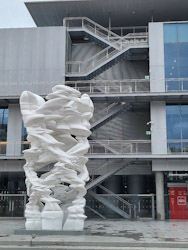
A MOSQUE DESIGNED by Mimar Sinan (c1489-1588), probably the best of Ottoman architects, stands a few yards away from Istanbul Modern (modern Art museum) designed by one of Europe’s best contemporary architects – Renzo Piano (born 1937).

The mosque is the Kiliç Ali Paşa, designed by Sinan and completed 1580. Like other mosques designed by this architect, the spaces contained within feel most satisfying. Sinan was masterful in his creation of contained spaces. The mosque with buttresses also has some attractive tiled panels both inside and outside.

One minute’s walk away from the 16th century mosque stand Piano’s Istanbul Modern, which was completed in 2004. Quite different from the mosque, it shares one thing in common – brilliant spatial design. Located next to the waterfront of the Bosphorus, brilliant views of Istanbul can be obtained from the waterfront, from the rooftop terrace, and through the gallery windows.

Piano’s building is so utterly engaging visually that it competes with the exhibits for one’s attention. Although many of the mostly Turkish artworks are both beautiful and engaging – we spent three hours looking at them, it is Piano’s building that steals the show.

I found it fascinating that two magnificent buildings, their constructions separated by 424 years, should be standing so close one another. Had I been in Renzo Piano’s shoes, I would have felt honoured to have one of my buildings so close to that of an architect who has easily passed the test of time.

At rest by the waters of the Bosphorus in a beautiful mosque

BY THE LATE SIXTEENTH century, Istanbul had become an extremely important crossroads between Asia and Europe. It was the capital of the Ottoman Empire, which by then extended over large parts of Europe, the Middle East, Egypt, and the north coast of Africa.

Part of the military force that the Sultan of the Ottomans used to maintain the empire was a group of soldiers called janissaries. These were (usually) Christian men who had been captured by the Turks, converted to Islam, and trained in military skills. They were often most effective soldiers.

Today (16th of April 2024), we visited an elegant complex of Islamic buildings close to the waterfront at Üsküdar on the Asian shore of the Bosphorus Straits. Designed by the famous Ottoman architect Mimar Sinan (c1489-1588) in 1580, it houses a former madrasa (now used to house a library), cloisters, a mosque to which is attached the turbe (edifice housing a grave, like a dargah, as can be found in India), and a small mosque.

This complex was commissioned by Ṣemṣi Ahmed Paṣa (1516 – 1580). Amongst his numerous achievements he was, for a time, head of the janissaries. He also served as the beglerbeg (governor) of several provinces including Rumelia (which included much of the Balkans and Romania) and Anatolia.

This lovely architectural ensemble is visited by some of the many tourists who stream past it, and by many pious locals.