
THE MOLLA ZEYREK mosque stands high on one of Istanbul’s seven hills. From its garden, which has a pleasant café, you can enjoy a wide panorama that includes views of the Bosphorus, the Golden Horn and bridges crossing it, the Galata Tower, the great Suleymaniya Mosque, and many other historic buildings around it. Turn your back on the view, and look across the well-kept flower garden, then you will see what looks like a large Byzantine church with three apses and several domes. However, as you stroll around this building, you will soon notice that it has its own minaret. This mosque was a church before 1453 when the Ottomans captured Constantinople/Istanbul.
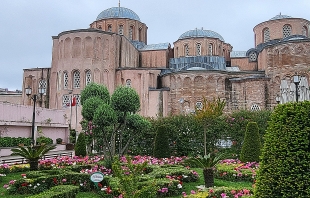
As is the case with many other places of historic interest in Istanbul, there is an informative notice outside the mosque, written in three languages (Turkish, Arabic, and English). It outlines the history of the mosque. The building, designed by the architect Nikeforos, was built in the 12th century by Eirene (died 1134), the wife of Emperor Ioannis II Komnenos (ruled 1118-1143). Her father was King Laszlo I of Hungary. The edifice which is, in fact three churches joined in one building were the churches of the large Pantokrator Monastery. This institution included a 50-bed hospital, a library, an old-age home, a sanctuary for lepers, a medical school, a pharmacy, and a holy spring. The triple church was exceptional because:
“Except for the Church of the Holy Apostles, no other Byzantine building received as many imperial burials. John II (1118-43) and Eirene (Piroska of Hungary), their son Manuel I (1143–1180), and his wife Bertha of Sulzbach, were buried there, as were the Palaiologan emperors Manuel II and John VIII in the 15th century. In front of Manuel’s black marble sarcophagus was the Stone of Unction (a marble slab on which Christ’s body laid after his crucifixion), which Manuel brought from Ephesus around 1170. The large funerary chapel of the Archangel Michael is described by the typikon as a heroon – the shrine of a hero later used for the imperial mausoleum of Constantine and his imperial successors at the Church of the Holy Apostles.” (www.thebyzantinelegacy.com/pantokrator-monastery)
These monuments can no longer be found in the building.
Soon after Mehmet the Conqueror captured Istanbul, the monastery was converted into a madrassa. It became the first educational establishment created by the Ottomans in Istanbul. The monastery’s monk cells became cells for the madrassa and the triple church, suitably modified with a minaret, a mimbar, a mihrab, and other Islamic features, became a mosque with two classrooms for religious instruction. One of the new establishment’s professors was Molla Mehmed Efendi, nicknamed ‘Zeyrek’ – now, part of the mosque’s name. This learned man not only offered education to those who were already Muslim, but also to those who converted to Islam. In addition, he was instrumental in persuading many local people to convert to his religion.
Apart from the former church complex, now mosque, the other monastery/madrassa buildings have disappeared. This century, what had become an unusable, badly dilapidated structure was restored, and is now back in use as a mosque. The mosque occupies the southernmost of the three chapels. The other two chapels, although attractively painted, were empty spaces. One of these once served as the Byzantine Imperial mortuary chapel.
The Molla Zeyrek Mosque was formerly a Byzantine church. When the Ottomans took Istanbul, rather than destroying the places of worship of their Christian enemies, they recycled or repurposed them – they modified the churches and converted them to become mosques. Probably, the best-known example of this is Istanbul’s enormous Ayasofya-i Kebir Cami-i Şerifi (i.e., the ‘Hagia Sophia Grand Mosque’), constructed in the 6th century. Apart from Ayasofya, which we walked past almost every day during our recent 16-day visit to Istanbul, The Molla Zeyrek mosque was one of the most impressive and largest former Byzantine churches that we saw in the city. However, my favourite of these recycled churches was near where we were staying: the Kucuk Ayasofya Mosque, in whose charming walled garden we enjoyed numerous glasses of tea, met many friendly Turks, and watched the antics of the garden’s large feline population.
I have visited many cities in America, Asian and Europe. Many of them are fascinating, but now I can safely say that amongst these wonderful places, Istanbul has become my favourite because here the past, present, and future blend together with an exciting vibrance.
 yamey
yamey 