
THE ARTIST HENRY Moore (1898-1986) is probably best known for his huge sculptures, a collection of which are on display at Kew Gardens until 31 January 2027. These massive artworks had small beginnings.
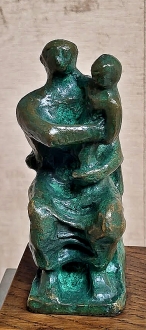
Moore’s large works began life as sketches and, often, as small maquettes (models or miniature sculptures that were often small enough to be held in the palm of a hand). At his country estate at Perry Green in Hertfordshire, one building was dedicated to making maquettes. The maquettes were rather like small three-dimensional sketches. At Perry Green, visitors can see hundreds of Moore’s maquettes, many of which never became developed further.
Plasticine, clay, and plaster were the malleable materials that Moore chose to use for creating maquettes. From the 1950s, he favoured plaster over other materials. It is malleable before it sets, and unlike clay that becomes very hard when dried, plaster is soft enough to cut or carved or inscribed after it has set. Maquettes that pleased him were later copied, modified as needed, to create the larger, final sculptures in various materials. Thus, the artist’s initial idea embodied in the maquette became realised as a finished sculpture.
Some of Moore’s maquettes have been cast into bronze, and make fine but tiny collectable sculptures. There is an exhibition of these bronze maquettes, each of them depicting female forms, at Richard Green Gallery in London’s New Bond Street. The maquettes are well-displayed, and on the gallery’s wall, there are informative panels with details about the artist and the way he worked. Some of the maquettes we saw must have been ‘precursors’ for several of Moore’s sculptures in Tate Britain.
We saw the exhibition on 24 June 2026. I rang the gallery to discover when the exhibition will finish, and was told that it will continue until all the maquettes are sold. So, if you have between £230, 000 and £1,000,000 going spare, hurry up and buy one!

