
Three hares or rabbits sharing three ears between them in a church in Buckinghamshire

WE HAVE COME ACROSS this type of curious motif once before in the parish church at Long Melford (Suffolk), and recently (September 2024) in the parish church at Long Crendon (Buckinghamshire). The motif consists of three hares (or rabbits) in a circle and joined by their ears which form a triangle at the centre of the design. Each creature appears to have two ears, but between them, they share only three ears. At Long Melford, this image can be seen in a small piece of mediaeval stained glass in a window on the north side of the church. At Long Crendon, it can be seen on a small 14th century tile close to the high altar.

According to the guidebook we obtained in the church at Long Crendon, the three hare/rabbit motif is only seen in a few places in Britain (including 12 of the Stannary villages in Devon and Cornwall, Long Melford, Lavenham, and Chester Cathedral). Also, it stated that it can be seen:

“… in a few places stretching from China to Europe along the Silk Road.”

Well, this got me very interested, and I did a little research on the Internet. Soon, I came across a website, “Three Hares Project” (www.chrischapmanphotography.co.uk/hares/page7.htm).  This site contains a mine of information including a map showing where the motif has been found along the Silk Route and other places.

The earliest examples that have been found are on the ceilings of  Buddhist caves near Dunhuang in China. They been dated as having been placed there between 581 AD and 907 AD. The three hares have also been found on a late 12th or early 13th century Iranian tray made of brass inlaid with copper. Another example was found painted on the ceiling panel that once used to adorn an 18th century German synagogue. The authors of the website noted:

“The three hares are also found in glass and ceramic wares from the Islamic world.”

So, it appears that the motif that we have seen in churches was not confined to Christian usage.

As to the meaning of the three hares/rabbits motif, the website offered the following:

“… as yet, we have not come across a contemporary written record of its meaning … The hare is strongly represented in world mythology and from ancient times has had divine associations. Its elusiveness and unusual behaviour, particularly at night, have reinforced its reputation as a magical creature. The hare was believed to have mystical links to the female cycle and to the moon which governed it.”

What it meant to Christians, who placed the motif in their churches, was suggested on the website. It said that the ancients believed that the hare was hermaphroditic, and could give birth to its offspring without need for copulation. In relation to this, the learned Thomas Browne (1605-1682) wrote in 1646 in his “Pseudodoxia Epidemica”:

“THE double sex of single Hares, or that every Hare is both male and female, beside the vulgar opinion, was the affirmative of Archelaus, of Plutarch, Philostratus, and many more. Of the same belief have been the Jewish Rabbins: The same is likewise confirmed from the Hebrew word; which, as though there were no single males of that kind, hath only obtained a name of the feminine gender.” (https://penelope.uchicago.edu/pseudodoxia/pseudo317.html).

This belief might have led Christians of old to compare the hare to the Virgin Mary and the birth of her well-known son.

Another less likely possibility is that the three creatures have something to do with representing the Holy Trinity.

Whatever its meaning, I find the motif of three hares sharing three ears almost as fascinating as the eagle with one body and two heads (the double-headed eagle, such as seen, for example, on the flag of Albania and the crest of the Indian State of Karnataka).
Monumental brasses lost from a church in Suffolk

IT IS NOT UNCOMMON to see gravestones with inlaid engraved brass images in English churches. Known as ‘monumental brasses’, they began to be used in the 13th century instead of three-dimensional effigies and images throughout Europe to commemorate the dead. These often-elaborate brasses are set in depressions carved in the tombstones where they are placed.

During a recent visit to the Suffolk village of Long Melford, we wandered around inside its enormous 15th century Holy Trinity Church. The long side aisles of this edifice are paved with tombstones, many of which have empty depressions where once there had been monumental brasses. A person looking after the church explained to us that long ago, the brasses had been prised out of the gravestones. This had been done both during the Reformation in the reign of Henry VIII and later by the puritans. Later, when the church had run low on funds, it sold some to a local blacksmith for what was then a huge amount – about £8 and 10 shillings.

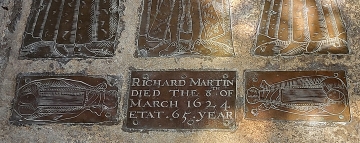
So much for the lost brasses. Fortunately, at the eastern end of the church, several monumental brasses have remained in place – some of them intact, and others damaged. To the south of the high altar, there is a set of intact 17th century brasses commemorating members of the large Martyn family. Included amongst these brasses are two of particular interest – they are Chrism brasses (see photograph above), which commemorate children who died before their mother was “churched” (that is before the mother has gone to church to give thanks to God for the birth of a child). The Chrism brasses depict babies in swaddling clothes. In addition to these brasses, there is another one depicts a brother and sister. The girl is holding a skull, which means that she died before her parents.

Churches in England, and especially that at Long Melford, offer many fascinating insights into how people lived in the distant past. The brasses – those which have gone and those which remain – are fine examples of history on display.

RARE SURVIVALS IN A MEDIAEVAL PARISH CHURCH IN SUFFOLK

DURING THE REIGN of King Henry VIII, many English churches were vandalised because of the monarch’s divorcing the country from the Roman Catholic Church. Many artefacts were destroyed in churches to erase their connection with the Church in Rome. These included carvings and stained-glass windows. Holy Trinity Church in the wool town of Long Melford in Suffolk was no exception. Above the south entrance to the church, you can see empty stone frames that once contained stone effigies of saints. Much of the 15th century church’s mediaeval stained-glass was also destroyed.

Luckily for us, some of the stained-glass survived. This is because it used to be located in the windows of the clerestory high above the long nave – out of reach of the people sent to destroy it. In recent times, the surviving windows have been restored and placed in the windows lining the north wall of the church. These windows are much lower than those in the clerestory, and are easily viewed from the ground. The windows depict both dignitaries and religious subjects, which were the main targets of the vandals who were destroying religious images.

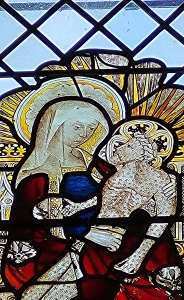
One of the windows is particularly interesting because it shows the Virgin Mary holding the dead body of Christ soon after it had been removed from the Cross. In other words, it is what is known as a Pietà. This subject matter was, and still is, extremely important in Roman Catholic imagery, and had they been able to reach it, those who attacked the church would have certainly wanted to destroy this.  A knowledgeable gentleman, who was helping in the church, told us that the pre-Reformation Pietà in the church was an extremely rare survival from the time before Henry decided to break with Rome. What is more is that unlike many images of the Pietà, the dead Christ is shown with his eyes wide open.

The Pietà image in the surviving mediaeval stained-glass is just one of many interesting things that can be seen in the magnificent, large parish church at Long Melford. As the Michelin Guidebooks often say, the place is “worth a detour”.

Queen of Hearts maybe?

HOLY TRINITY CHURCH in the Suffolk Town of Long Melford is a grand perpendicular gothic affair built in the 15th century when the town was prospering because of the then thriving wool trade. Fortunately for us today, several of the original stained glass windows have survived in reasonably good condition.

On one of these mediaeval windows, which survived the iconoclastic behaviour instigated by Henry VIII, depicts Elizabeth Talbot, the Duchess of Norfolk, who was born in about 1442. Her daughter was married as a child to Richard, one of the two princes murdered in the Tower of London in about 1483.

It has been suggested that John Tenniel, the Victorian illustrator of Lewis Carroll’s “Alice’s Adventures in Wonderland”, might possibly have visited Long Melford, seen the portrait of Elizabeth Talbot, and then modelled his illustration of the Queen of Hearts on that image on the window. Whether this was actually the case or just pure coincidence is up to the viewer to decide. I remain undecided.

Three hares sharing only three ears

There is a lovely parish church in Long Melford, Suffolk. Called Holy Trinity Church, it is a fine example of the perpendicular gothic style, completed in about 1484. Some of its windows contain old pre-Reformation stained-glass. A tiny circular piece of stained-glass above the north door of the nave depicts something unusual. It is hard to see with the unaided eye, but if you can manage to see it properly, you will notice something interesting. Known as the Hare Window, it depicts the heads of three hares and three hare’s ears. Each hare appears to have the usual two ears, but each of the three ears on the glass are shared by a pair of hares.

Although unusual, the three hare motif is not unique to Long Melford. Another example, a ceiling boss with three hares sharing three ears can be found in the Chapter House of the Church of St Peter and St Paul in Wissembourg, France, and another on a bell at Kloster Haina near Kassel in Germany (http://www.chrischapmanphotography.co.uk/hares/page3.htm)

A village, a school, and Jemima Puddleduck

LONG MELFORD IN Suffolk is a village that I have passed through several times. It was only during our most recent visit in August 2021, when we stopped there to see its church and Melford Hall that I realised that the place has a connection with Highgate School (in north London), which I attended between 1965 and 1970.

Melford Hall sits on land that was once owned by the abbots of St Edmundsbury. As with all monastic property, it passed into the hands of King Henry VIII when he ordered the dissolution of the monasteries in the 16th century. The king with an eye to profit rather than the prophets sold the properties he had confiscated to wealthy buyers (nobles, merchants, and lawyers). Melford Hall and its lands were sold to a local lawyer, William Cordell (1522-1581). His father was a personal assistant (‘steward’) to Sir William Clopton, a lawyer and owner of Kentwell Hall at Long Melford. Young Cordell was sent to study law at Lincolns Inn and was called to the Bar at the early age of 22. An active politician during the reigns of Queens Mary I and Elizabeth I and a founder of the Russia Company, William Cordell acquired great wealth. It was he that bought the estate at Long Melford along with its stately home, Melford Hall. In addition, he married Sir William Clopton’s granddaughter, heiress to estates in Lincolnshire and Yorkshire.

Cordell did not build Melford Hall, but he did modify it in various ways. However, he did build the nearby Hospital of the Holy and Blessed Trinity in 1573. Situated across from the cathedral-like parish church, this was an almshouse for 12 aged men and women. The Great Church of The Holy Trinity stands behind and above the almshouse. It is a superb example of 15th century gothic architecture and is distinguished by having a separate Lady Chapel, which cannot be entered from the church, at its east end. It is one of the only parish churches in the country, which was never part of an abbey, to have such a feature. Within this fine church, Sir William Cordell’s elaborate sculpted tomb can be found in the chancel to the right (south) of the high altar. He died childless.

Amongst other important roles, William Cordell became Recorder of London. He succeeded his acquaintance, another lawyer from Lincolns Inn, Sir Roger Cholmeley (c1485-1565). Sir Roger was the founder of Highgate School during the final months of his life. This is the school I attended many years later.

Thomas Hinde, author of “Highgate School. A History” wrote that after Cholmeley, William Cordell was the school’s greatest early benefactor. Connected with two other educational establishments, St Johns College in Cambridge and Merchants Taylors’ School, Cordell became a Governor of Highgate School in 1576.

When I was at Highgate, it only admitted boys. Some pupils, including me, were day boys, and others were boarders. The boarders lived in one of four houses: School House, The Lodge, Grindal House, and Cordell House. Grindal was named to commemorate Bishop Edmund Grindal (c1519-1583), who helped establish Highgate School and Cordell was named to honour William Cordell. Until We visited Long Melford, I had no idea about the reason for giving Cordell House its name.

Returning to Melford Hall, once the home of William Cordell, it has passed through many generations of the Hyde Parker family, who acquired the hall and its grounds in 1786 from a descendant of both William’s sister and his cousin, Thomas Cordell. In 1890. The Reverend Sir William Hyde Parker (1863-1931) married Ethel Leech (1861-1941) in 1890. Ethel had a cousin, who has become extremely well-known, the children’s author Beatrix Potter (1866-1943). She used to visit the Hyde Parkers at Melford Hall, where she stayed occasionally. She used to draw and sketch many features of the hall and its grounds. We were shown one of the bedrooms in which she used to sleep. Nearby in a glass-fronted display cabinet, you can see a toy duck, wearing the outfit that Beatrix had created for it. This duck was the inspiration for her book “The Tale of Jemima Puddleduck”, which was first published in July 1908.

I had seen photographs of Melford Hall, which made me want to visit it, and I was not disappointed. However, I had not expected to learn that the Hall and the village have connections with both Beatrix Potter and one of the earliest benefactors and governors of the secondary school I attended in Highgate. Our visit to Long Melford certainly broadened our minds, as the popular saying goes. I will leave you with how GK Chesterton, who attended St Paul’s School rather than Highgate, expressed this idea in his “The Shadow of the Shark”:

“They say travel broadens the mind, but you must have the mind.”