
Once prisoners were locked up here in Hampstead

EVERY NOW AND then, when touring around England, we have spotted village lock-ups. These were small places with barred doors where prisoners could be held briefly in a cell until more suitable accommodation could be found for them. These miniature jails were:
“… used in the eighteenth and nineteenth centuries to house criminals who were apprehended on suspicion of committing petty crime … Lock-ups were only temporary forms of imprisonment, usually for one or two people, before the local authorities of the day decided how to deal with the offender. Criminals could be released or sent to the closest large town for trial.” (www.essexlive.news/news/essex-news/historic-jails-essex-you-can-3227277).

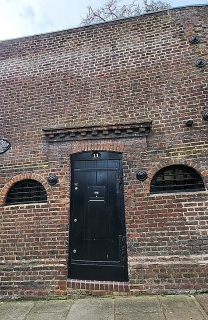
There were probably quite a few parish lock-ups in London, but now most of them have disappeared. However, if you walk along Cannon Lane in Hampstead, you will find one that has been preserved to some extent. It is within the garden wall of the grounds of Cannon Hall, which is where local magistrates held court, A plaque next to its entrance informs that the lock-up was established about 1730. Soon after the creation of the police force in 1829, the lock-house became disused, and prisoners were locked up in the Watch House that stands in Hampstead’s Holly Walk. Today, it seems as if the entrance to the former lock-house, flanked by two barred windows, is now the front door of some kind of residential accommodation.

For more information about Hampstead past and present, why not read my book:https://www.amazon.co.uk/dp/B09R2WRK92

Celebrities and criminals in Hampstead

THE ACTOR AND STAGE impresario Gerald Du Maurier (1873-1934) lived in Cannon Hall (14 Cannon Place in Hampstead) from 1916 until his death. His children, who lived there, included the novelist Daphne Du Maurier (1907-1989). The house was built in about 1720 and altered in the 19th and 20th centuries. Despite these changes, it remains an elegant residence in the heart of Hampstead.

The former lock-up

Steeply sloping, narrow Cannon Lane runs alongside the eastern wall of the grounds of Cannon Hall. About halfway down it (between Squires Mount and Well Road), there is a doorway in the wall. There is one semi-circular window on each side of it. Each of the windows is behind a lattice of metal bars. A plaque nearby informs the viewer that this was once a parish lock-up in which prisoners were held temporarily in a dark cell. The lock-up was established in about 1730. In that era, magistrates held court proceedings in Cannon Hall. In 1829, when a police force was set up in Hampstead, court business and prisoners were held in the Watch House on Holly Walk.

At the bottom of the grounds of Cannon Hall, stands Cannon Cottage, which faces Well Road. This was constructed in the early 18th century. Between 1932 and 1934, Gerald du Maurier’s daughter Daphne lived in this substantial residence with her husband Frederick Browning, whom she had just married.

Further west along Well Road, there is what looks like a small factory with skylights. This was built as artists’ studios in the late 19th century. Known as Well Mount Studios, the artist Mark Gertler (1891-1939) moved into number 1 in 1915, and worked there. I am uncertain how long he remained at this address, but I know he had moved from it before he committed suicide.

The places described above can be seen by walking only about 335 yards. This is typical of Hampstead Village (or Town, according to some), which is literally packed with interesting sites, both historical and contemporary. If you wish to discover much more about this fascinating part of north London, you can buy a copy of my informative book “Beneath a Wide Sky: Hampstead and its Environs” (from https://www.amazon.co.uk/dp/B09R2WRK92).