
A GARDEN IN HAMPSTEAD WITH A FASCINATING  HISTORY AND WONDERFUL PLANTS

GAINSBOROUGH GARDENS IS a cul-de-sac that leads southeast from Hampstead’s Well Walk, not far from one of the former homes of the artist John Constable. Houses are arranged around an attractive sloping oval garden, which was once part of the grounds of Hampstead’s once famous, now defunct, spa water centre and resort – the lost since demolished Long Room, which I have described this in my book “Beneath a Wide Sky: Hampstead and its Environs” as follows:

“These extensive premises were demolished in 1882 to make way for an estate of residential buildings. The former Pump Room and Assembly Room occupied a plot that is bounded by Well Walk, East Heath Road, and Gainsborough Gardens. Present day Gainsborough Gardens runs around an oval open space, which is shown as a pond in the gardens of the former Pump Rooms on an 1866 map. The pond was later filled in.

At the corner of Gainsborough Gardens and Well Walk, there is a tall building with attractive neo gothic windows. This was built in about 1704. Next to this house, but separated from it by Gainsborough Gardens, stands Wellside, a house built in 1892 on the site of the Pump Room.”

Yesterday, the 10th of April 2024, we visited Gainsborough Gardens with a friend of ours who introduced us to the friendly and highly informative couple, Adrian and Lynn, who look after the common garden within the oval. They had been the gardeners employed by the renowned pianist Katharina Wolpe (1931-2013), who had taken a great interest in the planting and planning of the oval garden. She had lived in Wellside, the house mentioned above. The gardeners told us that when she died, according to her wishes, she had bequeathed the plants in her garden to them, and they have since planted many of them in the oval garden.

Another famous person resided in Gainsborough Gardens. We were informed. That the author John le Carré (1931-2020) had lived in a house on the southwest part of the oval. As yet, there is no commemorative plaque for either him or Katharina Wolpe. According to Wikipedia, other notable residents of the Gardens included:

“ The family of songwriter Gary Osborne … The women’s suffrage campaigner Elizabeth Knight … The historian Bernard M. Allen … The Labour MP Arthur Greenwood … The former Governor of Northern Nigeria, George Sinclair Browne … Archibald Chisholm, the oil executive and former editor of the Financial Times … CE Maurice, who helped preserve Parliament Hill Fields and limit the expansion of construction onto nearby Hampstead Heath.”

Gainsborough Gardens, despite being a private ‘road’, is freely open to the public, and its centrally located garden is a delight to see.

[My book about Hampstead is available as a paperback and Kindle from Amazon:

https://www.amazon.co.uk/BENEATH-WIDE-SKY-HAMPSTEAD-ENVIRONS/dp/B09R2WRK92 ]

Taking the plunge in a cold bath at Kenwood in north London

I HAVE VISITED Kenwood House and its grounds innumerable times since my childhood, but it was only today (the 21st of March 2024) that I have been able to enter a part of it that has always been locked up whenever I have been there before. I am referring to a small building known as “The Bath House”. It is close to the courtyard where there are tables and chairs for visitors to use while enjoying refreshments.

A short staircase leads down to the door of the Bath House, which was probably already in existence when the Mansfields bought Kenwood and its grand house in 1754. The interior of the small edifice contains a circular pool. The wall around the marble-lined pool has several alcoves, and the concave ceiling is a plastered circular dome. What can be seen today is that is a faithful reconstruction of what had been there originally.

The pool used to be filled with cold water from one of the many iron-rich chalybeate springs in the area. In the 18th century, the chalybeate springs in nearby Hampstead were almost as famous and as much visited as those in Royal Tunbridge Wells (in Kent). The inhabitants of Kenwood House used to plunge themselves into the cold water because it was considered to be beneficial for health reasons in the 18th century.

It was only the select few who had the luxury of taking the plunge in such an elegant pool as can be seen in Kenwood. The other locals living in Hampstead had to make do with bathing in the many ponds that can still be seen dotted around Hampstead Heath. Within Kenwood House today, we saw a painting by John Constable (1776-1837) that depicts one of these ponds being used by bathers. For many years, the artist lived in Hampstead.

Small though it is, it was exciting to see within the Bath House at long last. For many decades, I have wondered what was within it, and now my curiosity has been satisfied.

A painting of Hampstead at Sotheby’s auction house

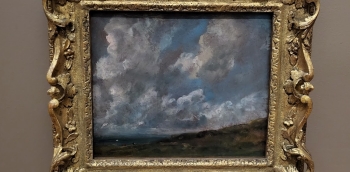
THE ARTIST JOHN Constable (1776-1837) lived at various addresses in London’s Hampstead. There, he created many sketches and paintings. He was extremely interested in depicting clouds – difficult subjects for an artist to portray convincingly, but Constable was able to do it well. Hampstead, high above most of the rest of London, provided a good spot for an artist interested in creating pictures of meteorological phenomena. High above the built-up parts of the city with no obstructions in his field of vision, Constable was able to set up his easel under a vast sky.

Recently (5th of June 2023), we visited the pre-auction viewing rooms at Sotheby’s in New Bond Street. In one of the galleries, paintings by ‘Old Masters’ were on display. One of them, which caught my eye, was by Constable, and labelled “Study for Hampstead Heath with a rainbow”. Valued at between £300,000 and £400,000, this picture includes a pond in the foreground; two people on the edge of the pond; some trees; a windmill with some small buildings near it; and a flock of birds flying above a small hill. This rustic scene is lovely, but what really catches the viewer’s attention is the sky. Constable has painted billowing clouds, which almost completely hide the clear sky behind them. Some of the clouds are white and others are ominously grey. Almost as accurate as a photograph, this cloudscape does more than slavishly reproduce what the artist saw – it manages to evoke what he must have felt seeing these clouds. And given the fleeting, ever-changing appearances of clouds, the artist must have worked swiftly to capture the celestial scene he saw.

Although I know that Hampstead once had a windmill near Whitestone Pond (now remembered by a lane called Windmill Hill), judging by its surroundings, the pond in the picture was not Whitestone. It might have been one that local enthusiasts he reconstructed recently – located beside Branch Hill. There is a painting in the Tate Gallery’s collections called “Branch Hill Pond, Hampstead Heath, with a Boy Sitting on a Bank”, which has a similar appearance to that which I saw in Sotheby’s, except that there is no windmill. Constable made many paintings and sketches that included the Branch Hill Pond, but apart from the picture I saw in Sotheby’s, which is a study rather than a finished work, they do not include a windmill.

A few months ago, I published a book about Hampstead and some of its interesting neighbours (including Highgate, West Hampstead, and Primrose Hill). Some people have wondered about the title I chose. It was because of Constable’s fascination with sky and clouds and his years of residence in Hampstead that I chose to give my book about the area the title “Beneath a Wide Sky: Hampstead and its Environs”.

My book is available from Amazon as a paperback or an e-book:https://www.amazon.co.uk/BENEATH-WIDE-SKY-HAMPSTEAD-ENVIRONS/dp/B09R2WRK92/

John Constable and a bookseller’s grave

ST JOHN’S IS the parish church for the C of E parish of Hampstead. The present building, designed by Henry Flitcroft and John Sanderson, was dedicated in 1747. It stands on Church Row, which is lined with elegant 18th century houses and links Heath Street with Frognal.

Church Row, Hampstead, London

The church is at the northern edge of a graveyard well populated with funerary monuments, including the grave of the artist John Constable (1776-1837). This grave is in the old part of the church’s cemetery, which was hardly used after 1878, when it was officially closed. A larger, newer graveyard is on a sloping plot across Church Row and north of St John’s. This is the burial place for a host of well-known people as well as the family of Hampstead’s Pearly Kings and Queens.  

When I used to visit Hampstead in the 1960s and early 1970s, I used to ‘haunt’ a most wonderful second-hand bookshop on Perrins Lane, which leads east from Heath Street. It was owned by an old gentleman, whose name, Francis Norman, I only learnt many years after he died. Recently, I met a member of Mr Norman’s family. He told me that Mr Norman died in 1983 and is buried in the cemetery at St Johns, describing the location as: “by a wall near Harrison and the children’s playground”.

I was not sure to whom he was referring when he mentioned “Harrison”. At the church, we asked a lady about Mr Norman’s grave.  Hearing that he had died in 1983, she suggested that we looked in the newer part of the cemetery. This has a wall that borders a children’s playground. When I looked around carefully, I found  neither any monument to Harrison nor Norman’s gravestone.

On returning to the church and explaining our unsuccessful quest, the lady sent me to see another church official, who was working in an office attached to the church. This lady knew exactly where Mr Norman was buried. She took me into the older part of the cemetery and showed me the gravestones of Francis and his wife Sonia, which lie next to each other. They are next to a small wall and close to a large monument to the clockmaker John Harrison (1693-1776). He was the inventor of a marine chronometer, which solved the problem of how to ascertain longitude whilst at sea. His story can be read in “Longitude” by Davina Sobell.  Norman’s grave is not far from that of John Constable.

Francis and Sonia Norman are amongst the few people buried in the old cemetery after it was closed in 1878.  My helpful informant at the church did not know why they had been interred there instead of in the newer part.

Francis Norman was a kindly, wise, and friendly fellow, who did not mind me and several of my friends spending hours in his shop, often spending very little on his extremely reasonably priced books. I have fond memories of the time that we spent in his presence, which are described in my book “Beneath a Wide Sky: Hampstead and its Environs” (https://www.amazon.co.uk/dp/B09R2WRK92).  So, it was with great pleasure that I met one of his family and was able to pay my respects at his grave.