
A RONDAVEL IS a traditional African hut found in South Africa. It is cylindrical and has a conical thatched roof. I first became aware of these in about 1957 when my aunt and uncle took me for a short holiday at Winterton-on-Sea in Norfolk (UK). We stayed at a seaside resort named Hermanus, after the popular holiday spot Hermanus on the coast of the Western Cape of South Africa. The accommodation at Norfolk’s Hermanus was a set of Rondavels built to resist the inclement North Sea climate. These rondavels continue to accommodate holiday makers today, as we discovered when we visited Winterton-on-Sea in mid-2025.
Later on that year, we visited the village of Veryan in Cornwall. This delightful place has 5 round houses that look like large rondavels. They were constructed in the early nineteenth century.
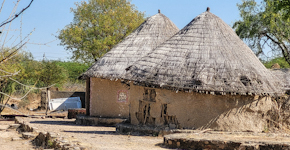
In December 2025, we visited Kutch, formerly a kingdom in its own right, but now part of the Indian state of Gujarat. As we drove through the countryside, we saw round huts with conical, thatched roofs. They looked just like the rondavels in South Africa. In Kutch, these rural dwellings are called ‘bhunga’. Like the rondavels in South Africa, their walls are made with mud. Often colourfully decorated, the bhungas were designed to withstand the region’s harsh climate and seismic activity. Many of the bhungas one can see house local country folk, but, just as at Winterton-on-Sea, bhungas have been built and furnished appropriately to provide picturesque accommodation for tourists.
As for their earthquake resistance, a website (www.kaarwan.com/) explained:
“Despite their humble appearance, Kutch Bhungas are remarkably resilient to seismic activity, thanks to their unique construction techniques. The circular shape and low height of the dwellings minimize the impact of earthquakes, while the flexible mud walls and thatched roofs absorb and dissipate vibrations, ensuring the safety of inhabitants during tremors.”
The idea of building bhunga huts was established after a terrible earthquake hit Kutch in 1819. Thus, to add a note of triviality, the concept of bhunga antedates the so-called bunga bunga parties of which the former Italian leader Silvio Berlusconi was so fond.
 yamey
yamey 