
Knife Edge outside the Houses of Parliament

THERE ARE MANY sculptures by Henry Moore (1898-1986) in London’s public spaces (see: https://londonist.com/london/art-and-photography/where-to-find-henry-moore-sculptures-in-london). One of them, “Knife Edge Two Piece”, can be seen on College Green, opposite the Houses of Parliament.  Consisting of two huge pieces of bronze, this was created by Moore between 1962 and 1965. Its form was inspired by a fragment of animal bone, as are many of his other sculptures. When we visited Moore’s home in Perry Green (Hertfordshire), we saw display cases filled with bits of bone the artist had collected over the years,

The sculpture outside the Houses of Parliament is one of three casts of the same work. The other two are in Canada and the USA. Moore donated the sculpture that stands in Westminster, to the Nation in 1967.  In 2011, it became part of the Parliamentary Art Collection. It is now a listed object. It is one of only 41 post-WW2 sculptures in Britain to have been awarded the listed status.

Henry Moore is one of the greatest of British twentieth century artists. It is fitting that his sculpture should stand amidst buildings that have played, and continue to play, important roles in the life of the country.
Houses of Parliament

westmin


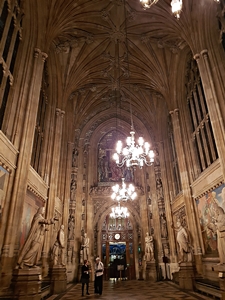
Recently, I attended an event, a performance of Albanian polyphonic singing by the ‘Grupi Lab’ ensemble from Vlore (Albania), in a room in the Palace of Westminster in the heart of London. For those who are unfamiliar with the Palace of Westminster, this enormous building contains the two Houses of Parliament.

To enter the Palace, it was neccessary to weave around the barricades put up to limit the activities of the Extinction Rebellion climate change activists. The public entrance is in Cromwell green, close to a statue of Oliver Cromwell. After a series of security checks that resemble those at Heathrow Airport, we followed a path that leads into the huge Westminster Hall. Although restored in parts, this hall dates back to 1097 AD. Its marvellous hammer beam timber roof  was built in the 14th century. Much of the timber is original, but some of it had to be replaced after a bomb struck in 1941.

After the concert, we decided to visit the public gallery of the House of Commons. After a short wait, we were issued with tickets and then escorted to another security check point. The examination here was very thorough. 

The public gallery overlooks the chamber in which Members of Parliament debate and make speeches. When we arrived at about 5.30 pm on the 14th of October (2019), there were more people in the public gallery than in the chamber. A Labour MP was delivering a lengthy, dull speech. Nobody seemed to be paying him the slightest attention.  After what seemed an eternity – actually, about ten minutes – he stopped. He was followed by a Conservative MP, who made an interesting speech, concisely and powerfully phrased. Again, this did not appear to interest anyone else in the chamber. During the couple of speeches we heard, we could see the few other MPs present sitting quietly, many of them fiddling with their mobile telephones or tablets. This, my first ever visit to a sitting of the House of Commons, was interesting but hardly scintillating.

What impressed me most about my visit to the Palace of Westminster was the staff. Everyone we encountered was not only helpful, but also kind and couteous. The ‘pomp and circumstance’ of the Palace did amaze me, but not nearly as much as the superb staff.