
The hands of women about to be consumed by fire

ON THE WALL NEXT to one of the several gates, the Daulat Prole, that leads into the Junagarh Fort in Bikaner, you can see a set of what look like the impressions made by pressing hands into a soft material. Each of these hand prints is labelled in Hindi (Devanagari) lettering. These impressions are amongst the last actions of widows about to commit sati.
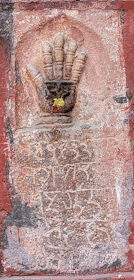
Sati was the usually forced self-immolation of widows. Sati was the tradition in India that involved widows being forced to throw themselves on their husband’s burning funeral pyre. Sometimes, they did it apparently voluntarily. It was a tradition often practised by Rajputs, but not restricted to them. During the British occupation of India, there were various attempts to outlaw sati, but incidences of it continued into the 20th century. Finally, in 1987, the Government of India passed an Act criminalising the practice of sati and its glorification.

Returning to the hands at the Junagarh Fort, one of the officials guides told us the following. Prior to being caste onto her spouse’s funeral pyre, the noble Rajput widow would dress in her finest clothes and jewellery, and approach the Daulat gate. By this time, her hands would have been covered with henna (mehndi). She would then press the palm and digits of her right hand on a stone slab, leaving a print of her hand on it. Later, an artisan carefully carved a three-dimensional impression of the widow’s hand. By that time, the poor woman had been incinerated.

In Rajasthan, various of the Princely States abolished sati in the first half of the 19th century. In Bikaner, the last Maharani to die on her husband’s pyre was in about 1825, so we were told by the guide at the fort.

My eye was immediately attracted to the sati memorials. I wonder how many other visitors to the Junagarh Fort stop and contemplate these tragic memorials before proceeding with taking photographs of each other at the many picturesque spots within the fort.
Look, no hands

WE VISITED TWO churches in Suffolk, and inside them we spotted three things that particularly interested us. The first church is in Cavendish, The Parish Church of St Mary the Virgin. Standing on a hill above the village, its construction dates from 1300 and was largely completed by 1485. Some restoration work was carried out in the 19th century. One of the two things that fascinated us in this church is affixed to the inside of the north wall. It is a bas-relief depicting the Crucifixion. It is a reredos of Flemmish make, created in the 16th century. It is framed in a Victorian surround designed by Ninian Comper (1864-1960) in 1895. The sculpted reredos was brought to the church from the private chapel of the hymn writer Athelstan Riley (1858-1945) in London, following his death.

Cavendish church

The other curiosity in this church, which has memorials to the philanthropists and local parishioners Baroness Sue Ryder and Baron Leonard Cheshire, is on a wall just behind the 19th century wooden pulpit within arm’s reach of the preacher. It is an hourglass, looking like a large egg-timer, which the priest could use to time his sermon. I had never seen such a thing in a church. Less curious but also fairly unusual are the 13 wooden crucifixes on the interior walls of the bell tower. These were made from wood salvaged from the Western Front during WW1 and each one commemorates one of the men from Cavendish who were killed in the conflict.

The other church we visited on our recent trip to Suffolk was St Mary in Stoke by Nayland, which was sometimes painted by John Constable (1776-1837), who was born nearby in East Bergholt. Built in Perpendicular Gothic style between 1300 and 1481 it is very majestic, like a small cathedral. The church is full of interesting monuments including many fine brasses. It was one of the funerary monuments that particularly intrigued us: the Lady Anne Windsor monument. Anne lived from about 1568 until 1615. A stone carving depicts her lying with her head on a pillow. At her feet, there is a carving of a kneeling man, Anne’s son. By her head, two carvings depict a pair of kneeling women, Anne’s daughters. Look closely at this pair and you will notice that their hands have been broken off. Their arms are merely amputated stumps. What is going on here?

Stoke by Nayland church

The answer is that in 1643, Parliamentary Commissioners visited the church in Stoke by Nayland and destroyed 100 religious images and 7 funerary items. Part of this over-zealous iconoclastic behaviour was the removal of the four hands of the two women on Lady Anne’s monument, as well as those of the recumbent figure of the deceased. All the hands of females on the monument were removed but those of the kneeling male figure were left untouched. Apparently, the female hands were removed because the Commissioners considered them to have been in “a superstitious attitude of prayer”, whatever that meant during the Reformation.

The three items I have described are but a few of the things worth seeing in the two churches. I have chosen to describe them because I have not seen such things in the many other parish churches I have visited in England.

Art and science

ART AND SCIENCE


From my childhood until I qualified as a dentist in 1982, aged 30, I drew and painted a great deal. Creating pictures was one of my favourite pastimes. In the late 1970s when I was already studying to become a dentist, I joined a weekly print-making class. It was held in the West Hampstead studio of my mother’s cousin, the etcher/engraver Dolf Rieser (1898-1983; see: https://dolfrieser.com/biography/ ). 

The image above is from an etching that I created in Dolf’s studio. It is a composition inspired by electron micography of intra-cellular structures. At the time I created it, I had just finished a PhD in a biological subject and was studying biology that was considered necessary to qualify as a dentist.  Interestingly, Dolf had also studied biology (genetics) in his youth, receiving a doctorate in the subject. He took to artistic pursuits after completing his studies in biology. Later in his life he wrote a book called “Art and Science” (published in 1972 by Studio Vista). Dolf was an inspiring teacher with a great understanding of compositional technique.

In 1982, I began practising as a dentist. It goes without saying that a dentist’s work involves a great deal of use of the hands and fingers. All day long, five days a week, I was doing the fiddly kind of things with my hands and fingers. Prior to qualification as a dentist, I had used my hands and fingers to create often complex images (drawings, paintings, etchings, and copper engravings). I found that my urge to create images diminished rapidly after I began practising dentistry. I suppose that the clinical activities satisfied my need to employ my manual dexterity in other ways. Sadly, now that I am retired I have not (yet) gone back to creating images. Now my fingers are kept busy at the keyboard, creating books and blog articles.

Essential accessories


It is amazing how many things, which used to be done with two hands, are now done with only one hand. It worries me to watch a parent manoevering a child in a baby buggy off a bus or train literally single-handed, often while looking at a mobile ‘phone screen.

Why only one hand nowadays? The answer is simple. Many people seem incapable of going anywhere or doing anything if one hand does not hold a mobile ‘phone or maybe a bottle of water.  

Why is it necessary to be permanently attached to a ‘phone? It can be kept in a bag or pocket within easy reach thus freeing up the hand for more productive uses. 

And, what has happened to human metabolism that requires a bottle of water to be carried about? I might be old-fashioned, but several decades ago, nobody felt it essential to carry a personal water supply. Have we become more thirsty as a species, or what?