
Masks of transgender faces and an artwork in London’s Trafalgar Square

THERE ARE FOUR stone plinths on London’s Trafalgar Square. Three of them bear statues of noteworthy men of the past. The fourth plinth, which is at the northwest corner of the square, was destined to carry a statue of King William IV, but it was never placed there. For many years, the fourth plinth remained unused, but from 1999 onwards it became used to display works of art. Works are commissioned for the plinth, and remain displayed on it for, typically, a year or two. This year’s artwork, “Mil Veces un Instante” (‘A Thousand Times in an Instant’) is by the Mexican artist Teresa Margolles (born 1963).
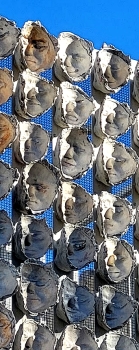
At first sight, the sculpture looks like a rectangular box-like framework covered with white ovoid shells, rather like halves of easter eggs. On closer examination, these shapes look like the internal surfaces of moulds taken from faces. Indeed, that is what they are. As an article on Wikipedia explained:

Casts of the faces of 850 trans people from London and around the world. The ‘life masks’ are arranged around the plinth in the form of a tzompantli, a skull rack from Mesoamerican”.

And a notice by the plinth informed the viewer that:

The casts have been created by applying plaster directly onto the faces of participants, meaning that as well as recording their features the plaster is infused with their hair and skin cells … The material is important to the work, it is fragile and will deteriorate (although not disintegrate) over time. The fragility of the material is a reflection community, both fragile and strong. The material also has a tendency to pick up other materials into the work. The material retains traces of the participants such as eyelashes, eyebrows, skin cells, makeup etc, they are present in the work.”

Well, what was the artist trying to tell the viewer? On 22 December 2016, Karla, a trans-gender woman, was found murdered in a Mexican city. According to the information panel, the work on the plinth is both a memorial to Karla and an object to raise awareness of the violence and abuse faced by so many transgender and other gender non-conforming people around the world.

Unlike some of its predecessors on the fourth plinth, Margolles’s work, is not particularly visually striking. Its strength lies in the concept that led to its creation. It expresses a message, but it is not one that is at all obvious to the casual passer-by. If one does not read the information panel, this work would make little or no impression on those who happen to notice it. I hope that the next piece to occupy the plinth will be more eye-catching, even though the present one is full of good intention.
One at each corner of the square

NOW FILLED WITH TOURISTS and pigeons, the area which is currently Trafalgar Square was where Royalty kept their hawks between the 13th century and 1534. In that year the Royal Mews, where the hawks were kept, burnt down, and were replaced by stables for the royal horses. The stabling was moved to Buckingham Palace in the reign (1820-1830) of King George IV. In 1826, the clearance of the stables from the area began, and following the plans of John Nash, a new square began to be laid out. Initially named in honour of King William IV, it was later named Trafalgar Square to commemorate Nelson’s victory at the Battle of Trafalgar in 1805. Nelson’s Column (145 feet tall) was erected in May 1854.

At each of the four corners of the Square there is a stone plinth designed to support a sculpture. At the northeast corner, the plinth supports a statue of King George IV. Major-General Henry Havelock (1795-1857), who was involved in suppressing the First Indian War of Independence, is perched on the southeast plinth. He died of dysentery in Lucknow after relieving Kanpur from a siege. General Sir Charles James Napier (1782-1853) is portrayed sculpturally on the southwest plinth. His mother was the great-granddaughter of King Charles II. As a Major-General in the Bombay Army, he led the British conquest (1843) of the Indian province of Sindh. It is said that on achieving this, Napier reported in Latin “Peccavi”, which means ‘I have sinned.’

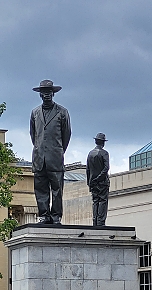
The fourth plinth on the northwest corner of the Square was destined to have a statue of King William IV. Because of insufficient funds, the king’s statue was never made, and the plinth remained empty until 1999 when the Royal Society of Arts (‘RSA’) conceived the idea of using the plinth to display a series of artworks by contemporary artists. Three artists displayed works between 1999 and 2001 on what is now known as The Fourth Plinth. Since 2005, under the supervision of London’s Lord mayors, a series of artworks by different creators have been displayed on the Fourth Plinth. Currently (since September 2022), the plinth (see photograph) displays a sculpture, “Antelope”, by Samson Kambalu. Recently, I heard this highly intelligent artist speak at a conference. His work on the plinth, based on a photograph taken in 1914, portrays the Baptist preacher and pan-Africanist John Chilembwe and the European missionary John Chorley. As the website www.london.gov.uk explained:

“The photograph was taken in 1914 at the opening of Chilembwe’s new church in Nyasaland, now Malawi. Chilembwe has his hat on, defying the colonial rule that forbade Africans from wearing hats in front of white people. A year later, he led an uprising against colonial rule.  Chilembwe was killed and his church was destroyed by the colonial police.

On the plinth, Chilembwe is larger than life, while Chorley is life-size. By increasing his scale, the artist elevates Chilembwe and his story, revealing the hidden narratives of underrepresented peoples in the history of the British Empire in Africa, and beyond.”

Kambalu’s piece is a powerful work of art, and its message of resisting colonialism, makes stark contrast to the exploits of the other people portrayed on the Square’s plinths.