
Washing the dishes as a kind of therapy

SEEING A PILE of unwashed pots and other cooking utensils reminded me of my father, who died aged 101 in 2020. A couple of years ago, I began writing my memories of him as a father, but have never completed the work. However, here is an excerpt that relates to my father and the kitchen sink:

Many people who knew my father would not have associated him with household chores. And that would be largely correct. My mother was more involved than Dad with the practical running of the household. However, there were a few things that he did on a regular basis. One of these was washing the dishes after a meal.

Dad had a rather puritanical attitude to work. Often, I felt that he considered it to be unworthy to stop working to relax, yet he did, but sometimes in an unusual way. He liked standing at the kitchen sink doing the washing of dishes, cutlery, and cooking utensils. By doing this, he was relaxing by being away from his desk, but he was not wasting time by doing nothing. He felt that he was achieving something useful whilst at the same time he was relaxing or just thinking about his academic work. When we bought our first dishwashing machine in the 1960s, I felt that Dad regretted it, because this machine had reduced the amount of time he could pass standing at the kitchen sink. Because my mother refused to put pots and pans and cooking knives in our machine, he was not entirely deprived of his time at the sink.

Having shared this with you, I will now head for our kitchen sink, and tackle the task that confronts me.

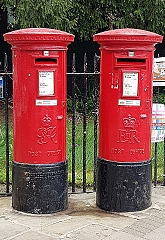
A pair of post boxes

WHILE WALKING IN CAMBRIDGE, I spotted a pair of pillar boxes. At first sight they looked identical but soon I realised that they were not. One had a wider orifice for inserting letters than the other. The wider one bears the ‘logo’ of Queen Elizabeth II and its neighbour with the narrower slit bears the logo of the Queen’s father, King George VI. Apart from these differences, there were much the same.

The two pillar boxes I saw in Cambridge are not particularly old. The first post box on the British mainland was placed in Carlisle in 1853. The idea of using such receptacles for collecting mail is connected with the author Anthony Trollope (1815-1882). An informative website (https://www.postalmuseum.org/collections/highlights/letter-boxes/#) related:

“Anthony Trollope, now more famed as a novelist, was, in the 1850s working as a Surveyor’s Clerk for the Post Office. Part of his duties involved him travelling to Europe where it is probable that he saw road-side letter boxes in use in France and Belgium.He proposed the introduction of such boxes to Britain and a trial on the Channel Islands was approved. Four cast-iron pillar boxes were installed on the island of Jersey and came into use on 23 November 1852. In 1853 the trial was extended to neighbouring Guernsey. None of the first boxes used on Jersey survive. It is possible that one still in use on Guernsey together with another in our collection, originally sited in Guernsey, date from the 1853 extension to the trial.”

Before the introduction of pillar boxes:

“… there was [sic] principally two ways of posting a letter. Senders would either have to take the letter in person to a Receiving House (effectively an early Post Office) or would have to await the Bellman. The Bellman wore a uniform and walked the streets collecting letters from the public, ringing a bell to attract attention.”

Well, all that history is news to me and I might not have bothered to find out about it had I not seen the father and daughter pillar boxes standing side=by-side in Cambridge’s Market Square.