
The first and only Queen of Haiti

UNTIL FEBRUARY 2022, only very few people with specialised knowledge of history would have been able to point out the house in which Marie-Louise Christophe lived in London between 1821 and 1824. Now, there is a plaque on the house in Marylebone’s Welbeck Street that marks the house in which she resided. And by now, you might well be wondering why anyone might want to know.

Marie-Louise (1778-1851) was born into a free black family, which ran a hotel, in St Dominique (which is now Haiti). In 1793, she married Henri Christophe (1767-1820), who had been one of her father’s slaves before he had earned enough in tips to purchase his freedom. After several years of revolution, in which Henri Christophe was an important freedom fighter, Haiti gained independence from France in 1804. In 1811, Henri was crowned the King of Haiti and the following year, Marie-Louise was given the title of Queen of Haiti. After the death of her husband in 1820 and the assassination of her two sons, she fled from Haiti along with her daughters. Their escape was assisted by the British, and they settled first in Blackheath, where they were hosted by the Anti-Slavery activist (abolitionist) Thomas Clarkson. After several changes of address, the Queen and her daughters settled in number 49 Welbeck Street.

According to the British press of the time, she and her daughters were popular with British people in all the social echelons. In 1824, they left London for Europe. Marie-Louise died in Rome, where she is buried. She never returned to Haiti. It was only in February 2022 that the Nubian Jak Community Trust were able to put up the commemorative plaque which you can see on number 49 Welbeck Street. It correctly describes Marie-Louise as “First and Only Queen of Haiti.”
The Poles in London’s Marylebone

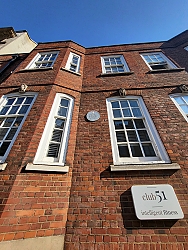
IT ALMOST GOES WITHOUT saying that wherever you are in central London, you are never more than a few footsteps away from a spot that has played a role in significant historical events. Most of these historical spots have been recorded, and therefore are not unknown to at least a few people. However, when walking around London, I often come across a memorial which I had not noticed before despite having passed it several times. Such is the case with number 51 New Cavendish Street – a brick building in Marylebone, which we have walked past several times recently.

Number 51 bears a commemorative plaque which has the following information:

“This building housed the headquarters of the Polish navy during 1939-1945”.

Underneath this, but in much smaller letters, are sixteen Polish names. From an informative website (https://wartimelondon.wordpress.com/2018/12/12/new-cavendish-street-and-the-free-polish-navy/), I learned that these are the names of Polish naval vessels -ships and submarines.

Poland became an independent country at the end of WW1. By 1920, then with only 90 miles of coastline, Poland began to construct a navy. This was based in Gdynia, near to the ‘free port’ of Gdansk (Danzig), which was not under Polish control. In 1939, with little chance of withstanding attack by the Germans, Polish naval vessels began leaving the Baltic, and heading for British waters. In late 1939, Polish Naval Headquarters were established at 51 New Cavendish Street. Although the Poles had administrative control over their vessels, operational control was dictated by British military requirements. Between 1939 and 1945, the number of men working in the exiled Polish Navy increased from 1000 to 4000.

After the end of WW2, in September 1946, the Polish Naval Detachment in the UK was disbanded. One of its warships was handed back to the new Communist government of Poland. Only a few of the naval personnel felt able to return to their native land now that it was under Communist rule.

Well, I knew a little about the exiled Polish Air Force and have visited Audley End House, where Polish Special Operations Executive personnel trained before being dropped behind the lines in German-occupied Poland. I have even eaten dinner at a Polish Airman’s Club in South Kensington, but this place’s restaurant might well have closed since then. However, until my most recent visit to New Cavendish, I did not know anything about Poland’s navy and its role in WW2.

Buried in Madeira

IN CENTRAL SARAJEVO, there used to be a pair of footprints carved on the corner of a pavement where two roads met. I do not know whether these impressions, which I saw in the 1980s, still exist. They marked the spot where a young sharpshooter, Gavrilo Princip, took aim and assassinated Archduke Franz Ferdinand of Austria-Hungary in 1914. Had his aim not been so accurate, the last Emperor of Austria might not have been buried in a church high above the city of Funchal in Madeira.

Emperor Karl of Austria-Hungary

Had Princip’s aim not been so good,  his victim, Franz Ferdinand, would have been successor to the imperial throne. With the Archduke eliminated, his nephew, Karl (1887-1922), succeeded Emperor Franz Joseph when he died in 1916.

Following the end of WW1 in 1918, Austria’s last Emperor, Karl, fled to Switzerland. After a couple of attempts to regain his throne,  the British exiled him and his wife to Madeira in 1921.

In 1922, Karl died of pneumonia.  He was interred in a chapel on the north side of the nave in the Igreja Nossa Senhora in the Monte district high above Funchal.

Plenty of tourist gawp at Karl’s simple tomb in the lovely church, which overlooks the city and the Atlantic Ocean far below.  I wonder whether Madeira would have been the final home of the Archduke had he not been so unlucky in Sarajevo.

Curiously, Karl was beatified in 2004. Equally strange was the British choice of a Portuguese island for Karl’s exile. After all, Napoleon Bonaparte was eventually exiled to a British possession: St Helena.