
A little England high up in the hills of southern India

WRITING IN 1931, the Spanish missionary Father Emilio noted:

“The Protestants in Munnar … appear arrogant and presumptuous and form a stark contrast to the humble pagans and submissive Catholics …”

The writer was referring to the British tea plantation owners and officials and their attitude to their Indian workers, both Hindus and those who had converted to Roman Catholicism.
 

31 years later, and after India had become independent,  another Spanish missionary, P Fermin, observed that Munnar (in Kerala) was conceived as:

“… as a meeting centre, with pretentions of an English town,  to break the routine of their [The British] plantation life on weekends. Munnar has its European club, …”


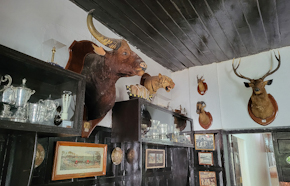
Now in 2026, the above-mentioned club, the High Range Club, still thrives, although now it is no longer exclusively for Europeans. We visited it several times in January 2026. Entering it is like stepping into the past.


The Club was established in 1909 on a large plot of land (6 acres) next to and high above a river. It was built as a residential  club, and has 17 rooms. Membership is restricted to corporate planters (senior officials of the tea plantations) of the Munnar area. As the club has many affiliations with other ‘elite’ clubs in India, many of the people who make use of its facilities are members of affiliated clubs.


Not only does the club’s architecture and interior design look like a leftover of bygone Britain,  but it preserves the old British club traditions and dress code rules. The Club has a wonderful old fashioned bar. Stepping into this is like going back to England of the 1930s or even earlier. Sadly, the High Range Club does not have a liquor licence.


On one of our visits to the Club, I looked at the board that listed the Club’s chairmen. From 1909 until 1973, all the chairmen had British surnames. It was only in 1974 that a chairman, Mr Murthy, had an Indian surname. And until 1966, none of the Honorary Secretaries had Indian surnames. Given this information,  I  wondered how many years elapsed before non-Europeans were admitted to the Club  after 1947 when India became independent.


Prior to the admission of Indians, the Club, like almost all of the British colonial clubs, were places where Europeans could isolate themselves from the Indian population. Today, these clubs provide a refuge for better-off Indians, who wish to socialise amongst themselves away from the ‘madding  crowds’.


The room used as the dining hall at the High Range intrigued me. At one end of it, there is a proper stage with curtains that could be used for performing plays and other entertainments. Seeing it reminded me of “A Passage to India” by EM Forster.  In it he described a British colonial club and how its members performed amateur theatricals. Here at the High Range is an example of exactly what Forster described.


Visiting the High Range is not only a pleasant way to pass a few leisurely hours, but it is also a chance to glimpse into the strange world that was once a feature of British India, albeit one that enforced a racial colour bar.

Somewhere snooty in Ooty (Ootacamund in south India)

ABOUT TWENTY-FIVE years ago, we spent a short holiday in the southern hill station at Ootacamund (Udhagamandalam) in India’s Tamil Nadu state. Often called ‘Ooty’, the town is the home of one of India’s most prestigious colonial-style clubs, the Ootacamund Club, which was founded in 1841. It was there that my in-laws arranged for us to stay for a few nights. Our bedroom with a working wood fireplace was comfortable enough. It reminded me of rooms in old-fashioned hotels in which I had stayed in with my parents in the English countryside in the late 1950s.

When we stayed at the club in 2000, it seemed to be quite a ‘snobby’ or ‘snooty’ place. We were travelling with our then five-year old daughter. Apart from our bedroom, there were only two parts of the club that she was permitted to enter. One was a lobby, and the other was a children’s dining room. The latter was depressing to say the least. Because we did not want to abandon our daughter, we saw little else of the inside of the club.  The rest of the club house could only be entered by adults wearing appropriate clothing. For men in 2000, this included a jacket, shirt, proper shoes (not trainers or sandals) and tie. It seemed crazy to enforce such rules as we were the only people staying in, or using, the club  during the off-season. I wonder if these rules have been relaxed at least a little since our visit.

It was not my first visit to Ooty. My wife and I had spent part of our honeymoon there after our marriage in Bangalore in January 1994. That time, my father-in-law had arranged for us to stay in the St Margarets guest house that belonged to the company in which he had worked, ITC. Our stay at St Margarets was not without small problems, but the place suited me much more than the hallowed Ooty Club.

Night at the opera

OPERA IS FOR THE ELITE or, at least, for those who can afford the often-high seat prices. London’s Covent Garden used to offer some reasonably priced tickets, but these only gave access to seats or standing places far away from the stage, from which one could hear the performance, but one only saw what looked like ants moving around on the stage. Once I had one of these ‘budget’ seats at a performance given by the ballet dancer Rudolf Nureyev. I was so far from the stage that, even though my eyesight was excellent at the time, it could have been almost anyone or anything flitting about in time with the music so far away from me. The best I can say is that I have spent time under the same roof as the great dancer even though I could hardly see him.

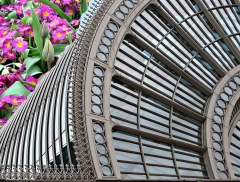
Floral Hall, Covent Garden, London

In early 1994, my wife, Lopa, became aware that a foundation was offering Covent Garden opera tickets at radically reduced prices to members of south Asian minority communities to introduce them to the joys of western European opera. Lopa decided to investigate this generous offer aimed at what the foundation assumed were ‘culturally deprived people’. She rang the organisation to ask how to become involved in the scheme. An ineffably patronising but kindly lady replied:

“Which community do you come from, by the way?”

“I am Gujarati.”

“All you need is a letter from the association that represents your community.”

“I don’t belong to such an organisation,” Lopa responded.

“Never mind, dear, why don’t you start one, and then contact us again?”

Not once did the lady ask Lopa if she had ever been to the opera. I suppose she assumed that south Asians never watched western European opera.

A short time later, Lopa sent a letter to the foundation on paper she had headed with the words: ‘Gujarati Worker’s Association of Kensington.’ Soon after this, she was accepted on to the scheme, which offered several tickets for each of a selection of top-class opera performances. These tickets were for the best seats and were priced at less than a fifth of their full price, which was still not an inconsiderable amount of money. We attended about six operas, sitting no more than three rows away from the stage. Sitting in these wonderful seats, which in 1994 cost well over £130 each, spoiled me forever. I do not think that I would be happy to attend another performance at Covent Garden unless I sat in seats with as good a view as those subsidised by the foundation.

On one occasion, we invited my father to join us. He was quite familiar the opera house at Covent Garden, having sat in the Royal Box several times with his colleague Lord Robbins, who was Chairman of the Royal Opera House. He accepted our invitation and we sat in wonderful seats watching an opera. I cannot remember which one we saw, but what happened in the interval, has remained in my memory. Dad said that he would treat us to champagne and smoked salmon sandwiches in the so-called ‘Crush Bar’, an exclusive refreshment area in the opera house.

We arrived at the Crush Bar, where a uniformed flunkey stopped all who wished to enter.

“We need a table for three,” my Dad explained.

“I am so very sorry, sir,” replied the flunkey, “all the tables are taken”.

My father reached into his pocket, and withdrew a £10 note before saying:

“Would this help you find a table?”

“Please follow me, sir,” replied the flunkey as he led us to an empty table.

Incidentally, the refreshments my father bought the three of us cost far more than we had spent on the subsidised tickets. 

At each of the subsidised performances we attended, we saw few if any other south Asian or any other people of non-European appearances in the audience. Sadly, the foundation abandoned their scheme about a year after we had joined it. There might have been other schemes that followed it, but we never found out about them.  

Oh, in case you are wondering about the Gujarati Workers Association of Kensington, whose creation was encouraged and suggested by the lady at the foundation, which shall remain unnamed, it still has only one member.