
Some sculptures at an auction house in London’s Mayfair

THE FAMOUS SCULPTOR Elisabeth Frink (1930-1993) was a regular visitor to our family home in Hampstead Garden Suburb during the 1960s. During that period, I met her whenever she was invited home for dinner, but then I was too young to realise how famous an artist she had become. She was a good friend of my mother, Helen Yamey (1920-1980), who was also a sculptor. Elisabeth and my mother got to know each other when they were both creating art in the Sculpture Department of the St Martins School of Art, when it was in Charing Cross Road.
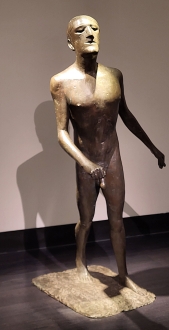
By Elisabeth Frink

Today (15th of November 2024), I was reminded of my mother’s friendship with Frink when we entered Christie’s auction house in Mayfair. We always enter this place when we are passing near it to see some of the works of art that are on display prior to being auctioned. You never know what gems you are likely to see. Today, there was a small collection of British art created during the past 100 years. Amongst the works on display were two by Elisabeth Frink. There were also some pieces by Henry Moore (1898-1986) and by Barbara Hepworth (1903-1975). One of the works by Hepworth was a painting, the other two were sculptures. Each of these artists has become some of the greatest of 20th century British artists.

During the first half of the 1960s, my mother’s sculptures were chosen to be exhibited in prestigious exhibitions, mainly in London. In these various exhibitions, her work was selected to be exhibited alongside the creations of the three artists mentioned above, as well as other artists, who have now achieved fame (e.g., David Hockney, Paula Rego, Michael Ayrton, and Bridget Riley). Despite this, my mother’s artistic work is now largely forgotten. In my recent book about her, “Remembering Helen: My Mother the Artist”, I describe her life, her character, and consider why her art, which was judged worthy of display with the best artists of the time, has faded into obscurity.

[The book is available from Amazon: https://www.amazon.co.uk/REMEMBERING-HELEN-MY-MOTHER-ARTIST/dp/B0DKCZ7J7X/]

Remembering Helen Yamey, who was my mother and an artist

My mother, HELEN YAMEY (1920-1980) was born in South Africa. In 1948, she came to the UK, and by 1952, she had become a sculptor. In the 1950s and ‘60s, she worked in the Sculpture Department of London’s St Martins School of Art alongside now famous sculptors including Elisabeth Frink, Anthony Caro, David Annesley, Eduardo Paolozzi, Menashe Kadishman, William Tucker, and Phillip King. Helen’s work was of a sufficiently high quality for it to be selected for showing in exhibitions that included the above-mentioned artists as well as others including David Hockney, Henry Moore, Barbara Hepworth, Paula Rego, Bridget Riley, Duncan Grant, and Jean Arp. Yet, unlike the artists listed, she and her work have become largely forgotten.

In my biography of Helen, “Remembering Helen: My Mother the Artist”, I describe her career as an artist, what she was like as a person, and explore why she did not make a reputation like those with whom she worked and exhibited. The book contains illustrations of many of Helen’s sculptures, and my daughter, Mala Yamey, an art historian and curator, has written notes about my mother’s sculptural works.   

The book is available as a paperback in other Amazon marketplaces, such as https://www.amazon.co.uk/REMEMBERING-HELEN-MY-MOTHER-ARTIST/dp/B0DKCZ7J7X/ .

There is also a Kindle edition.

An interesting intersection

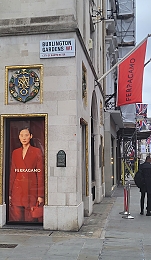
WHERE BURLINGTON GARDENS meets the south end of New Bond Street and the north end of Old Bond Street, there are two things that reminded me of my late mother.

One of them is a shop in a colourfully decorated building. This edifice used to be the home of Atkinson’s – a firm that sold perfumes and beauty products. Founded in 1799, it moved to the building on the corner of Burlington and Old Bond Streets in 1832. The decorative building is surmounted by a carillon of 23 bells, which is played by hand occasionally – to celebrate both public and private special occasions. Currently, the ground-floor is occupied by a branch of Ferragamo’s. And this firm has a connection with memories of my mother.

Salvatore Ferragamo (1898-1960), born in Italy, was a designer of luxury shoes. His clients included the Maharani of Cooch-Behar, Eva Peron, and Marilyn Monroe. He died in Florence (Firenze), where he had a shop on the Via dei Tornabuoni. This shop was close to Via del Giglio, where we as a family used to spend a fortnight in the city every year until I was about 15.

One of my clearest memories of our sojourns in Florence was not the Uffizi or the famous Duomo or the Medici Chapels, or even Michelangelo’s statue of David, but Ferragamo in Via dei Tornabuoni. You might wonder why. It was not that I have a shoe fetish or any great interest in footwear. It was because of my mother. Hardly a day passed without us having to enter Ferragamo’s to watch my mother trying on several pairs of shoes. For a youngster like me this was not an interesting way to spend my precious school holidays. And what is more, I cannot recall my mother ever buying a pair of shoes in that shop.

Facing Ferragamo’s on the corner of New Bond Street and Burlington Gardens, there is a small paved open space. In the middle of it, there is a bronze sculpture of a horse and rider. This was sculpted by Elisabeth Frink (1930-1993). My mother was also a sculptor and met Frink (or ‘Liz Frink’, as we knew her) at St Martins School of Art (in Tottenham Court Road), where they both worked in the Sculpture Department. They became close friends. I used to meet Liz Frink when she was invited to our house for dinner occasionally.

The Frink sculpture has been on Bond Street since 2018. Before that, it was located at the corner of Dover Street and Piccadilly, where it was placed in about 1975. As for the branch of Ferragamo’s that faces it across Burlington Gardens, I am not sure how long it has occupied its present site. However, it was only today that it occurred to me that the intersection of the two Bond Streets with Burlington Gardens has a connection with recollections of my mother.

The blind beggar and his dog

AN ELIZABETH AND AN ELISABETH figured in my mother’s life during my childhood years. One was the cookery writer Elizabeth David (1913-1992), whose recipes my mother followed faithfully. The other was the sculptor Elisabeth Frink (1930-1993). Although she never met the cookery writer, she was a good friend of the sculptor. Between 1954 and 1962, Frink taught sculpture at St Martins School of Art, which was then located in Charing Cross Road. During that period, my mother, a sculptor, worked in the sculpture workshops in St Martins. It was probably then that she and Elisabeth became friends. ‘Liz Frink’, as we knew her, visited our home in Hampstead Garden Suburb as a dinner guest regularly and I remember meeting her on these occasions. My memory of these meetings was revived when visiting London’s East End this month (March 2022).

We were walking eastwards along Roman Road from Globe Road towards the Regents Canal when we passed the Cranbrook Estate, a collection of six rather bleak looking blocks of flats. The buildings are arranged around Mace Street, which is in the form of a figure of eight. The estate was built on land which had formerly accommodated a factory, workshops, and terraced houses. The blocks were completed by 1963. They were designed by Douglas Bailey and Berthold Lubetkin (1901-1990). Born in Georgia (Russian Empire), Lubetkin lived in Russia during and after the 1917 Revolution. He studied in Moscow and Leningrad (now St Petersburg), where he became influenced by Constructivist architectural principles. In the 1920s, he practised architecture in Paris, and by 1931, he had emigrated from the USSR to Great Britain, where he mixed with the artistic community then based in Hampstead (see my book: https://www.amazon.co.uk/dp/B09R2WRK92). In London, he founded Tecton, an architectural practice. He is particularly well known for his Penguin Pool at London Zoo and his luxurious block of flats in Highgate: High Point. The flats he designed on the Cranbrook Estate were for social housing.

Various other buildings and features have been added to the estate. One of these is a triangular garden surrounded on two sides by rows of single storey houses (bungalows for the elderly). In the middle of this, the Tate Garden, there is a pond with a fountain. Perched on what looks a bit like a diving board made of concrete discs piled one above another, there is a sculpture of a man and a dog. As soon as I saw this, I was reminded of Elisabeth Frink’s sculptures. Later, when I investigated it, I discovered that it is a sculpture by her. Entitled “Blind Beggar and his Dog” and cast in bronze, Liz Frink created this in 1958, which was when she and my mother must have already become friends. A sculpture depicting the Blind Beggar and His Dog, who figure in a tale that gained popularity in Tudor times, was commissioned in 1957 by Bethnal Green Council. Incidentally, there is a Blind Beggar pub in Whitechapel Road, where in 1966, the gangster Ronnie Kray shot dead a member of a rival gang, George Cornell.

We had visited the area near the Cranbrook Estate to see a small exhibition. As it had not taken long to view it and it was a warm sunny day, we took the opportunity to roam around the area. Had we not done that, I doubt that I would have become aware of this sculpture by an old friend of my mother.