A narrow escape

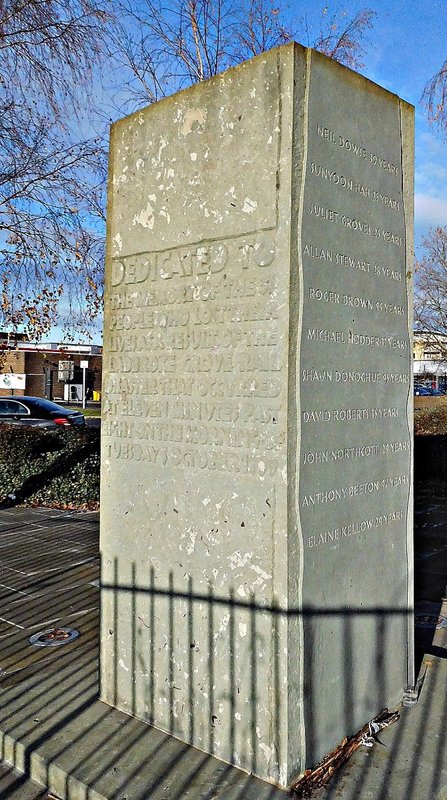
Ladbroke monument


My first job as a dentist was in a lovely practice in the Medway Towns. After having worked there for eleven years, I married and then lived in London. As it became tiring commuting by car between Kensington and north-east Kent, I changed practices. I worked for about nine months in north-west London in a practice where I was not happy. Then, I moved to another practice near Portobello Road. After about four years, the owner of that practice decided to open another branch in Maidenhead, Berkshire. I thought it would be interesting to work in a brand-new practice, and as Maidenhead was served by a good rail connection from Paddington, which is near my home, I decided to move to the new practice, where I treated its very first patient.

Usually, I boarded a local train that left Paddington a few minutes past eight in the morning. Just over half an hour later, I used to disembark at Maidenhead station, which was a couple of minutes’ stroll from the practice. Of the patients whom I treated there, the less said the better. My best memory of the place was that it was near a wonderful sandwich shop. The people who worked there had no idea about portion size control. So when I ordered my favourite sandwich, filled with prawn mayonnaise, it contained so much filling that I could hardly get my mouth around it.

One Monday evening, I returned to Paddington a little earlier than usual. Not being in a great hurry, I bought a ticket for the following Monday’s journey to Maidenhead.

On the following day, Tuesday the 5th of October 1999, I arrived at Paddington early as usual. Having already bought my ticket the evening before, I was able to take the train that left a few minutes earlier than the one I usually boarded. It left just before 8 am. The train I normally travelled on left a few minutes after 8 am.

I arrived at Maidenhead and began working. In those days, I used to have a radio running in my surgery. I heard a news bulletin that mentioned that there had been a terrible rail crash. I thought nothing of it until I returned to Maidenhead station that afternoon. I discovered, to my annoyance, that no trains were running as far as Paddington. They were all terminating west of Paddington at Ealing Broadway, where, fortunately, there is an Underground line which allowed me to continue my homeward bound journey.

It was only when I reached London that I learned more details about the crash. The train that I normally boarded every morning, the one which left a few minutes past 8 am, had collided head-on with a high-speed express train coming in the opposite direction on the same set of rails. Later, it was reported that 31 people had died and over 500 were injured. Most of the victims, killed and injured, were on board the train that I missed taking because I had bought my tickets on the night before.

There is a monument to those who died in the crash. It is near the large Sainsbury supermarket on Ladbroke Grove. Whenever I see this simple stone monument or think about the incident, I shudder. One of the names on that memorial could have easily been mine.

If the judge allows

blur close up focus gavel

Photo by Pixabay on Pexels.com

I was a little intimidated by his appearance the first time he walked into my surgery. Tall, well-built, he clutched a half eaten sandwich in one hand and a bundle of papers in the other. When he had finished masticating the piece of sandwich in his mouth, he told me that the police had banned him from entering the area. Waving his collection of papers, he explained that his solicitor needed to get permission from the police when he needed to see a dentist at the practice.

P wanted a new set of dentures. Inwardly quaking, I took the primary impressions of his toothless gums, and then asked him to return a week later for the next stage of his treatment. By the end of the appointment, I felt that he was going to be a pleasant patient and that I need not fear him.

On the penultimate appointment, I tried the wax mock-up of his dentures to check that all was proceeding well. I let P look in the mirror. He was very pleased and wanted to take them away. I explained that the waxed version had to go back to the technician to be made into the final, usable plastic product. I told him that they would be ready in a week.

Looking crestfallen, P said :”really ? That might be awkward?”

I asked why.

“I am seeing the judge next week. If he puts me behind bars, I won’t be able to collect the teeth.”

I asked him if he could let me know if he was unable to return.

“Sure, doc,” he said, “I can phone you from prison.”

I said to him: “I see now. That’s what people mean by a ‘Cell phone'”

P gave me a huge toothless grin.

P did return for his teeth a week later, but I was not at work. I’d had to cancel my clinic to attend our daughter’s birth.

Keep your hair on

Mr T was a regular attender at my dental surgery. Bald, he had a high pitched voice. For some years he made appointments on Saturday mornings because he commuted during the weekdays. He retired and then began coming to see me on weekdays.

One Thursday just before Mr T was due to enter my surgery, our receptionist rushed in and said : “Don’t be surprised when you see Mr T.”

A few moments later, a woman in fairly dowdy, quite unfashionable clothes walked in and sat in my dental chair. When this person with a good crop of hair greeted me, I recognised Mr T’s voice and his familiar face was framed by his unfamiliar hair. I looked at my dental nurse, and she looked back at me, astonished.

As I always did, I asked the patient whether he/she had any medical problems lately, or had to see the doctor lately. The transformed Mr T said “not at all.”

Puzzled, I performed the dental check up, and discovered that there was a tooth that required extracting. T consented to this and we arranged for him to return a week later. He/she left the room.

In those days, early in my career, whenever I performed a tooth removal I asked the nurse to support the patient’s head gently during the procedure.

As soon as T left the room, my nurse said to me: “Don’t expect me to support his head next week. What if his wig were to come off in my hand?”

A week later, dressed as before in dowdy women’s clothing and with a full head if hair, the previously bald and previously male-attired T turned up for his extraction.

Before commencing, T asked me in his high-pitched voice which was now in complete harmony with his female appearance: “Will this take long?”

I said: “Only a few minutes. Are you in a hurry?”

“Slightly,” T replied, “I am going shopping with my wife in a quarter of an hour.”

I suspect that throughout his working life, T had yearned to appear female, but only in retirement was he able to make his fantasy into reality. His wife must have been a very understanding woman.

Ouch! Pull it out!

dent 1

When I qualified as a dentist back in 1982, there was no vocational training period during which the newly qualified dental surgeon worked under the guidance of an experienced practitioner. Like others who graduated at that time, I was plunged into the ‘deep end’. I was fortunate that the owner of the first practice where I worked was understanding and helpful. He provided me with much valuable advice.

However, nothing can prepare you for the unexpected.

One day, a new patient sat in my dental chair. He spoke English with an eastern European accent. He may have been Ukranian. He said to me: “It is my philosophy that when I am having pain from a tooth, I remove it from my mouth.” Having just spent five and a half years training to save troublesome teeth, I asked him whether he was certain that he did not want an attempt to be made to save the tooth. He was adamant: he wanted the tooth out.

When he pointed at one of his upper incisors, a tooth that was visible when he spoke, I asked him again whether he would not prefer to save such a prominently visible tooth. Once again, he explained his philosophy.

With some reluctance, I administered the local anaesthetic to render the proposed extraction painless. While his jaw was going numb, I asked him once again whether he was sure that he wanted to lose the tooth. He did not change his mind.

It is usual to check for numbness the area around a tooth that is to be removed. This is done by prodding the area with a sharp-pointed probe. As I began to do this, the patient pushed my hand away sharply. Before I could ask him why he did this, he grabbed the offending tooth with his thumb and forefinger, twisted sharply, and cleanly extracted the whole incisor with its root intact. My assistant and I stared at the man, totally surprised.

He said: “All I needed was the injection. The rest I can do myself”. Needless to say, I did not offer him a discount.


dent 2


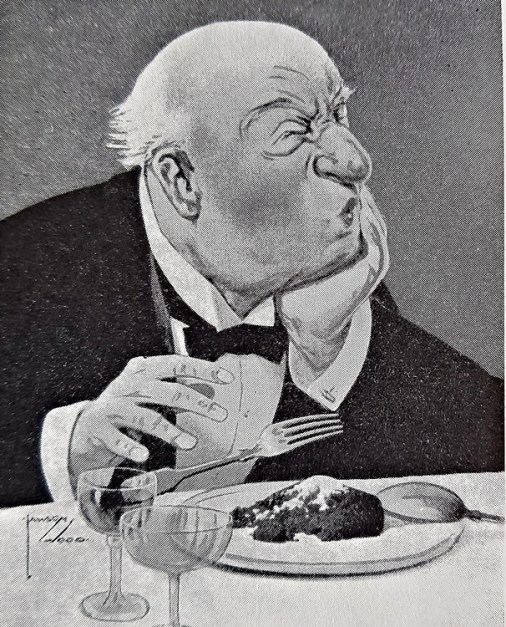
Pictures from “Der Zahnarzt in der Karikatur” by E Heinrich, publ. 1963