
THE WALL SURROUNDING the fort of Jaisalmer is about three miles in circumference. It encloses a warren of narrow streets and small squares and is home to several thousand residents.
It was during the reign of Akhai Singh, 1723 to 1762, that people began leaving the town around the fort to establish homes within it. They began laying out streets and mohallas (neighbourhoods) within the well defended fort. This continued until 1891. Why it should have stopped in 1891, I do not know yet. Suffice it to say that this fort, like that at Carcassonne in France, is one of the few forts in the world that is still home to a settlement of local people. It is a “living fort”, not a museum.
The fort and its contents form the main tourist attraction of Jaisalmer. Like Venice in Italy, it feels as if the tourists outnumber the locals. Many of the buildings in the fort cater to the tourist trade: guest houses, shops, and eateries. And there are plenty of men who are keen to guide you around the fort for a modest fee. However, the services of a guide would spoil, rather than enhance, the pleasure of exploring this attractive place. The best way to enjoy the fort and the richness of its ornate, yellow sandstone buildings is to lose yourself in the maze of narrow streets.
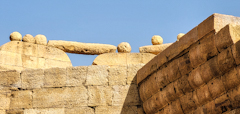
The fort’s construction commenced in about 1156 AD. You do not need to be particularly observant to notice that upon many of the fort’s outer walls there are heavy-looking stone balls and roughly hewn stone cylinders. These were placed, ready to be rolled down on enemies attacking the fort at close range. The fort has been attacked several times over the centuries. But I hope that it will not be attacked again. In the unlikely event that another assault will be planned, I am pleased to report that the stone balls are already in place.

 yamey
yamey 