
Hepworth and Mondrian in Salisbury

IN THE 1930s, both the sculptor Barbara Hepworth (1903-1975) and the painter Piet Mondrian (1872-1944) lived in Hampstead (north London). Hepworth and her two successive husbands lived and worked in the Mall Studios near Parkhill Road. Mondrian lived at 60 Parkhill Road. According to one of Hepworth’s biographers, Eleanor Clayton, writing in “Barbara Hepworth. Art and Life”:

“The beginnings of a friendship between Hepworth and Mondrian can be seen in her letters to Nicholson at the time: ‘so glad Mondrian said nice things about me & work. Goodness U did learn a LOT.’”
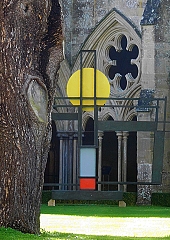
Visitors to the cloisters of Salisbury Cathedral can see an abstract sculpture at the southeast corner of the grassy space enclosed by them. At first sight, it looks like a sculptural version of a painting that might have been created by Mondrian. It is a sculpture by Barbara Hepworth called “Construction (Crucifixion)”. This bronze artwork was created in 1966, and then donated by the artist to the Cathedral in 1969. It is according to a notice by the sculpture:

“… Hepworth’s response to Christ’s Crucifixion …”

The interpretation of the piece’s symbolism is far from simple, as a website text (https://www.salisbury.anglican.org/news/the-crucifixion) explained:

“What we see are 3 verticals linked by a single horizontal bar, and by 2 other horizontals at different heights.

A large circle, attached to the intersection of the horizontal and vertical lines, is painted citrus yellow on one side and blue on the other. At the bottom of the central vertical, we see red on its own beneath the blue side of the circle, and red and white beneath the yellow. On the yellow side, a metal hoop encircles the point of crossing.

Hepworth wrote that she found it ‘very serene and quiet’, but that doesn’t have to guide what we make of this piece. We could see the yellow circle as the sun, the blue circle as the moon, the red paint as blood, the 2 verticals on either side as the crosses of the 2 men crucified with Jesus.

Or we could contemplate its hardness, weight, size (12ft tall and 2-and-a-half tons) and stark simplicity. We could seek to find meaning here, or we could stand before it and try to imagine the experience of meaningless horror and sheer emptiness which brutality of any kind must impose on those who witness it. For us, it need not seem ‘serene and quiet’ as for Hepworth. On the contrary this cross might confront us with the tragic lack of meaning which has so often afflicted humanity since the cross of Christ was first set up.”

Whatever its symbolism, Hepworth’s piece is attractive and looks good surrounded by the gothic architecture of the cloisters. Above all, its appearance immediately brings to mind thoughts about thw works of art created by Mondrian. One website (https://artistscollectingsociety.org/news/barbara-hepworth-sculpture-returns-salisbury-cathedral-permanent-display/) describes the piece as “Construction (Crucifixion): Homage to Mondrian” and then continued as follows:

“The sculpture is thought to explore the duality of Jesus Christ in its use of geometric symbols and features bold colours borrowed from the palette of ACS member Piet Mondrian, referenced in the artwork title.”

I was very pleased to see this work once again in March 2022, soon after publishing my book about Hampstead, past and present, in which I have included a substantial chapter about the modern artists who lived and worked in the area between the two World Wars. There is a good chance that Hepworth’s encounters with Mondrian and his work whilst they were both in Hampstead is reflected in the appearance of this abstract Crucifix, which stands in the cloisters at Salisbury.

PS My book, “Beneath a Wide Sky: Hampstead and its Environs” is available from Amazon (https://www.amazon.co.uk/dp/B09R2WRK92).

An isolated Anglo-Saxon chapel

A FEW MONTHS AGO, we paid a brief visit to Mersea Island, which is off the coast of Essex. While we were wandering around on the island, we spoke with a man, who recommended that we visit the isolated chapel of St Peter-on-the-Wall, which is not far from Bradwell-on-Sea, also on the coast of Essex. He thought that we would enjoy its tranquillity and the beauty of its surroundings. In early August 2021, we drove beyond Bradwell-on-Sea to a carpark, which is 785 yards west of the chapel known as St Peter-on-the-Wall. The building is about 300 yards west of the east coast of Essex on the Dengie Peninsula, the southern lip of the mouth of the River Blackwater. The chapel stands on a hill overlooking the surrounding coast and countryside.

Winding the clock back to the time when the Romans ruled Britain, we find that there was a fort named ‘Othona’ near the site of the chapel. It was one of a series of Roman forts created to protect Britain from Saxon and Frankish pirates, possibly built by a Count of the Saxon Shore, a Roman official, named Carausius, who died in 293 AD. A Roman road ran up to the fort, connecting it with places further inland. During the 7th century, the Romans having left Britain, an Anglo-Saxon holy man, Cedd by name, landed at Othona in 653.

Cedd (born c620) was one of four brothers. He had a religious upbringing and education in the monastery set up by Saint Aidan (c590-651) at Lindisfarne on the coast of Northumbria. Cedd became a missionary. After successes in the Midlands, he was invited by Sigbert, King of the East Saxons, who reigned in Essex, to bring Christianity into the area. Cedd sailed from Lindisfarne and landed at what was the ruined fort at Othona. He moved north later in life and died in 664 (of the plague) near Lastingham in Northumbria, where he had founded another religious establishment.

Cedd’s first church at Othona might well have been wooden, but soon he built one of stone, of which there was plenty lying about in the ruins of the fort. His stone church is built in what was then the style of churches in Egypt and Syria. Apparently, Celtic Christians, such as Cedd, were influenced by this style. Building a church in the ruins of a Roman fort mirrored that which had been built in the ruins of a fort by St Antony of Egypt. The location of the former fort on the Roman road might have appealed to Cedd as it would have facilitated ‘spreading the word’ inland.

The church that Cedd built used to have a chancel and possibly other parts, as it was part of a monastic complex based near Bradwell.  Cedd’s church, St Peter’s, simple as it was and is still, can be considered the first cathedral to have been built in Essex. It is considered unlikely that the monastery Cedd created near Bradwell survived the Danish invasions. Soon after Cedd’s death, Essex was incorporated into the diocese of London and St Peter’s became a minster, the chief church in the area. When the parish church of St Thomas was built in Bradwell-on-Sea, St Peter’s became relegated to being a ‘chapel of ease’. Services were held three times a week there until at least the end of the 16th century. Sometime after this, the chancel was pulled down; the church was left standing as a navigation beacon; and the building was repurposed as a barn. As a barn it remained until the early 20th century, when the church was reconsecrated and restored in 1920.

The church is still in use. Services are held there under the auspices of the nearby Othona Community, based nearby at Bradwell-on-Sea. At present, services are held on Sunday nights in July and August at 6.30 pm.

We walked across the fields to St Peter-on-the-Wall, which is one of Britain’s oldest still standing and working churches. After some difficulty, we managed to open the one door to the church. We entered the building’s simple and peaceful interior. A colourful crucifix, created by Francis William Stephens (1921-2002) hangs high up on the east wall. St Cedd is depicted praying at the feet of Jesus on The Cross. The supporting stone of the simple stone altar has three fragments embedded in it. One of them was a gift from Lindisfarne, another from Iona, and the third from Lastingham. The altar was consecrated in 1985. Apart from a circle of chairs for congregants and a timber framed ceiling, there is little else in the church apart from a feeling of tranquillity, which can only be experienced by visiting this charming place. The man at Mersea Island, who suggested that we visit St Peter-on-the-Wall, did us a good turn.