THROUGHOUT MY LIFE, I have been visiting or passing through St Johns Wood in north London. I have often noticed a street called Woronzow Road. It lies between Primrose Hill and St Johns Wood Underground Station. Whenever I have seen this road, I have wondered about the name ‘Woronzow’, but uncharacteristically I have always been too lazy to find out anything about it.
Recently, we visited Wilton House in Wiltshire, not far from the city of Salisbury. Home to the Herberts, the Earls of Pembroke, for many centuries, this is a wonderful place to visit, to see its gardens, the house itself and the outstanding collection of old master paintings within it. The decoration of the rooms that we saw is superb and is kept in good condition by the house’s present occupants, the family of the current, the 17th, Earl of Pembroke. It was whilst visiting this splendid country seat that my ears pricked up hearing the guide mention the name ‘Worontzow’.
In 1808, the widowed George Herbert (born 1759) remarried. His second wife was Catherine Woronzow (1783-1856). Her father was Semyon Romanovich Woronzow (1744-1832), Russian Ambassador to England from 1796-1806, who died in London and was buried in the Pembroke’s family vault. Catharine, who became Countess of Pembroke, did a great deal to improve Wilton House to create much of what we can see today. She is buried in the nearby church of St Mary and St Nicholas, which was built in a neo-Romanesque style between 1841 and 1844. It was built at the instigation of Catharine and her son Sidney Herbert, the 14th Earl of Pembroke (1810-1861).
Between October 1853 and February 1856, the last years of Catharine’s life, Britain was at war with Russia in what is known as The Crimean War. Between June 1859 and July 1861, Sidney Herbert was the Secretary for War in the British government. During the campaign, a supply route called the ‘Woronzow Road’, no doubt named in honour of Catherine’s noble Russian family, ran along the Crimean coast past Sebastopol. Thus, there was once a Woronzow Road in The Crimea. This was an important supply route for the British forces bringing much-needed material south from Alma and Calamita Bay towards Sebastopol. In the winter of 1854, the British lost control of this vital supply route and had to rely on goods reaching them by a far more difficult track,
One of Sidney Herbert’s great contributions to the war effort in the Crimea was his asking Florence Nightingale (1820-1910) to travel to Scutari (now, Üsküdar in Istanbul) with 38 volunteer nurses. She and her team helped to dramatically improve the treatment of the many soldiers who contracted diseases such as cholera and typhus whilst in the Crimea. Incidentally, Florence never visited the Crimea, but remained working in the Turkish city. Herbert and his wife had first met and become friendly with Florence Nightingale in Rome in about 1847.
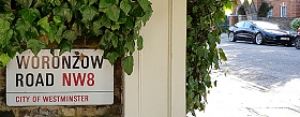
Now let us return to St Johns Wood in London. Catherine’s father, Semyon Worontzow, lived in the district. The road, where he lived and whose name has intrigued me for decades, is now called ‘Woronzow Road’. It was named after him in 1843. It was not until 2002 that the Russians erected a monument to him on the thoroughfare named after him.


 yamey
yamey 