
THE ARCHITECT CHARLES HOLDEN (1875-1960) designed many stations for the London Underground, mainly on its Piccadilly Line. Each of these incorporates features of Art Deco and Modernism. Holden designed a new headquarters building for the forerunner of London Underground, the Underground Electric Railways Company of London. Now known as 55 Broadway, it was built between 1927 and 1929. The Underground company occupied it from 1933 until 1984, when it became the headquarters of London Regional Transport, and then its successor Transport For London. After 2020, it has served other purposes. The ground floor is occupied by both a shopping arcade and the entrance hall to St James Park Underground Station.
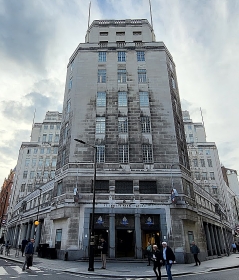
55 Broadway is a tall, cruciform building surmounted by a clock tower. One of the reasons for this shape was to ensure that all of the offices within the cruciform tower, the bulk of the edifice, were close to the external walls, and therefore had access to plenty of daylight. Apart from looking impressive, the building is not highly decorative, and not as attractive as some of its architect’s designs for Underground stations. Having said this, it is not entirely devoid of decorative features.
What makes 55 Broadway of special interest is the set of sculptures attached to its exterior. Near to ground level, there are two large figurative works by the artist Jacob Epstein (1880-1959), one called “Day” and the other “Night”. When they were unveiled, prudish members of the public objected to them, as is revealed in an article on Wikipedia:
“The modernism and graphic nakedness of these sculptures created public outrage on their unveiling. Newspapers started a campaign to have the statues removed and one company director, Lord Colwyn, offered to pay the cost. Frank Pick, the managing director of the UERL at the time, took overall responsibility and offered his resignation over the scandal. In the end, Epstein agreed to remove 1.5 inches (38 mm) from the penis of the smaller figure on Day and ultimately the furore died down.”
Much higher up the building, between the fifth and sixth floors, there are bas-relief sculptures depicting the four winds. Two are by Eric Gill (1882-1940), one is by Samuel Rabinovitch (Samuel Rabin: 1903-1991), and another by Henry Moore (1898-1986). And within the Underground station, I noticed four mosaic panels. Called “Angels of History”, they were created by London-based Hannah Quinlan and Rosie Hastings, and installed in 2024.
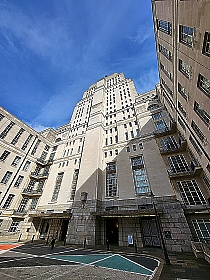
What was once an important headquarters building is still a place where fascinating works of art can be seen, as well as being an example of Modernist architecture in London. Soon after 55 Broadway was completed, Holden designed the University of London’s Senate House. Like 55 Broadway, it impresses the viewer, but lacks the visual appeal of Holden’s Underground stations.
 yamey
yamey 