In the style of Adam at a town in Suffolk

I HAVE VISITED Bury St Edmunds, a town in Suffolk, many times since my childhood in the 1960s. However, it was not until June 2025 that I first stepped inside the town’s Athenaeum. Located in the heart of the town, this edifice began life in the 17th century. It was converted into an Assembly Room in 1714, and then in 1853, it was modified to become the Athenaeum. Today, it is used for special occasions, such as weddings.

The highlight of its interior is the ballroom designed by Franciss Sandys, who died in the 1820s. .The barrel-vaulted ballroom is the full height of the building. What impressed me was that its beautiful stuccoed ceiling resembled the kind of ceilings designed by the great architect Robert Adam (1728-1792).

Raise your eyes in this church in central London

THE STRAND IS a street in the heart of London, which runs close to the River Thames. It used to be close to the water. Hence, its name. Two churches stand like islands in this busy thoroughfare. One of them is St Clement Danes, and to the west of that is St Mary Le Strand, which we entered today (the 17th of May 2024) after visiting the Photo London exhibition at nearby Somerset House.

St Mary Le Strand was designed by James Gibbs (1682-1754) and constructed between 1714 and 1717. It was built on the site of a great maypole, which was the centre of May Day celebrations in the 16th and 17th centuries. The church’s interior is in an exuberant baroque style, reflecting its architect’s earlier travels and training in Italy.

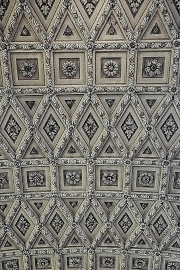
The walls of the nave are bare. It had been intended to have been painted, but this never happened. What really attracts the eye is the amazing geometric ceiling above the nave (see photograph). The ceiling is an expanse of triangles, squares, and lozenges that cover its barrel vaulting. In the centre of each of these many shapes, there is a sculpted flower. This ceiling was designed by Chrysostom Wilkins, who worked on other churches in London. It was created in plasterwork, shaped by hand, without using moulds.

St Mary Le Strand has been open less regularly than its neighbour St Clement Danes. Although I have visited the latter often, I believe that today was either the first or one of a very few visits to St Mary Le Strand. If you happen to be passing this church, and it is open, do take a few minutes to admire its wonderful ceiling.

The place where the artist Tiepolo was born in Venice

GIOVANNI BATTISTA TIEPOLO (1696-1770) is one of my favourite artists. I have been familiar with his works ever since my childhood, when we visited Venice annually from the late 1950s or early 1960s onwards. My parents took me from church to church to see the great master’s paintings, which I prefer to the somewhat more photograph-like paintings of Canaletto.

We used to stay in a pensione on the Fondamente Zattere, a waterfront facing across a wide canal to the Giudecca island. The Gesuati church was a few yards from where we resided in Venice. It contains ceiling panels and a wall painting, all created by Tiepolo. Often, we passed the church and almost always entered it to gaze up at Tiepolo’s ceiling. I cannot remember it, but my sibling recalls that almost every morning, early, my father used to stand quietly and alone in the church for a few minutes.

I became so keen on Tiepolo that I broke my train journey between Ostend and Vienna to spend a night in Würzburg in order to see Tiepolo’s paintings in the city’s Residenz (a palace).

This September (2022), I was walking along a narrow passageway (Calle S Domenico) when I spotted a commemorative plaque above an archway leading into a long narrow courtyard surrounded by tall residential buildings. The plaque recorded that in the courtyard there was the house in which Tiepolo was born on March 1696. Exactly in part the courtyard, the Corte S Domenico, the artist was born, I could not determine. However, I had never seen this place before and was thrilled to have stumbled across the place where one of my favourite artists was born.