
THE FIRST TIME we drove from Bhuj to Dholavira, home of Harappan ruins, the journey via Bhachau and Rapar took about six hours, not including stops for refreshments. This route runs around the large Lake of The Rann of Kutch. We made this journey in January 2020. Since then, a new road has been built. It reduces the journey to less than three hours.
The new road, which runs roughly parallel to India’s border with Pakistan is part of a highway constructed to allow rapid movements of military vehicles. When India is under attack, or at risk from it, the thoroughfare is closed to non-military traffic. To call it a highway is a bit misleading. The new road, NH754K, consists of a single lane of tarmac, which is the width of a large lorry. The tarmac strip is flanked on each side by gravel carriageways that are wide enough for large trucks. When driving along the highway if two vehicles are approaching each other, one needs to swerve off the tarmac onto the gravel carriageway so that the two vehicles do not collide head to head. Many drivers, especially those in huge trucks and fancy SUVs expect cars approaching them to move off the tarmac and onto the gravel which is full of sharp rocks.
The new ‘highway’ traverses the Lake of The Rann of Kutch along a recently constructed causeway. This is about 30 km (18.6 miles) in length. It traverses a narrow island about half way along its length.
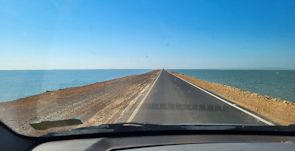
Known variously as ‘Way Through Heaven”, “Road to Heaven”, “Road through Heaven”, etc, the causeway is flanked on both sides by the waters of the vast lake through which it runs. Apart from the frequent swerving to make way for approaching vehicles, driving along the causeway is a magical experience. The shallow waters of the lake reflect the sun in varying ways. Far in the distance, beyond the lake, one can see hills silhouetted against the bright blue sky.
The water in the lake derives from the monsoon rains, and remains there until the end of the hot season just prior to the rains. Then, the lake dries out. When the lake is full, it attracts a variety of waterfowl. The most fascinating of these creatures are the huge number of pinkish flamingos. Because the lake is very shallow, many of the flamingos we saw were standing in the water rather than swimming.
Apart from its military purpose, the Road to Heaven has made it easier for tourists to visit the ruins at Dholavira. This has brought prosperity to the previously hardly visited island on which the archaeological site is located. On our recent visit in December 2025, we saw that Dholavira had become much more developed for tourism than it was back in 2020, when facilities in the area were rudimentary to say the least.
For many people today, the journey to Dholavira is being made not primarily because of an interest in archaeology, but to enjoy the heavenly sensations experienced while crossing the lake on the causeway. And there is nothing wrong with that: the causeway provides visitors with a wonderfully memorable experience.
 yamey
yamey 