
THE SEAPORT MANDVI in the Kutch district of the Indian state of Gujarat was founded by Maharao Khengarji I, the ruler of the kingdom of Kutch, in 1580. It became an important, thriving centre of trade for several centuries. And for over 400 years it has been a place where dhows have been built. Today, these huge wooden ships can be seen in various stages of construction along the banks if the Rukmavati River on whose shore lies the town of Mandvi.
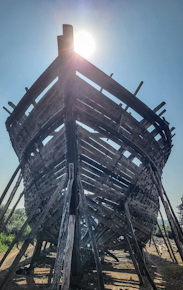
The dhows are constructed largely by hand as they have been done for over 400 years. They are built with timber, sal wood, imported from Malaysia. Today, the timber is landed at the port of Kandla in Kutch a d brought by road to Mandvi.
According to an article in the The Hindu newspaper dated April 2017:
“As maritime trade grew, traders—belonging to the seafaring Kharva community of both Hindus and Muslims—developed a new expertise: boat-making and repairing to add to their traditional navigational skills.”
Furthermore , the arti le related, the dhows:
“… built by hand by craftsmen who are barely literate and have no training in engineering, the ships come up expertly without so much as a sketch being referred to.”
I found this to be quite amazing.
The dhows take several year to be built. When they are completed, they are usually towed to the Persian Gulf where they are fitted with engines. Occasionally, engines are fitted in Mandvi.
Having been fitted with engines in the Gulf, they return to Mandvi with a small crew. Back in Mandvi, the dhows are loaded with cargo and a larger crew before sailing back to the Middle East. About a year after they have been completed, the dhows are sold in the Gulf or East Africa.
Whereas in the past, the dhows had a capacity of about 40 Tonnes, some of those being built today can carry up to 2000 Tonne.
Whenever we visit my wife’s cousins, who lives close to Mandvi, we take a walk along the road next to stretch of shore where the dhows are being made. The huge timber structures, upon which men are assembling the ship using hand held tools. The workmen appear to cling to the beams of timber as they worked on the ship. They do not wear safety harnesses.
The ‘embryonic’ dhows are surrounded by piles of uncut timber as well as the planks that have been cut prior to being attached to the ships being constructed. Apart from the building materials, the area contains numerous stray dogs and the occasional foraging cow.
Mandvi is about 250 miles northwest of Alang (in Saurashtra, Gujarat), which we have visited. It is in Alang that ships that have reached the end of their lives are broken up. I was interested to read in The Hindu article that in Mandvi:
“The boat-makers use old generators discarded from dismantled ships lying in Gujarat’s Alang ship-breaking yard. These are then modified by installing gear boxes in them and converted into boat engines.”
I have no idea for how much longer the handmade dhows will continue to be built in Mandvi. So, if you are able, a visit to Mandvi to see this traditional boat building is well worthwhile. It is handicraft on a huge scale.
 yamey
yamey 