
Rabindranath Tagore, blood, and coffee in Calcutta

THERE IS A BRANCH of the India Coffee House chain in College Street, Calcutta. Housed on the first and second floors of Albert Hall (built 1876 in memory of Victoria’s Prince Consort), it is located in the midst of a vast bazaar specialising in bookselling – mainly textbooks and technical manuals. Soon after it was opened, the coffee house within Albert Hall became a centre of anti-British agitation.

The first floor serving area – many chairs and tables – is overlooked by two huge portraits. One photograph depicts Rabindranath Tagore as a young man and next to this, there is another of the poet and writer Kazi Nazrul Islam. Other smaller painted portraits line the walls of the café. Waiters wearing pugrees busily wandered around taking orders and delivering food and drinks – mostly coffee.

This ninth of January (2024) was a special day when an annual blood donation camp was held in memory of the Bengali footballer Sailendra Nath Manna (1924-2012). It was, as we discovered today, being carried out on the second floor gallery overlooking the serving area of the College Street India Coffee House.

Loudspeakers within the coffee house and in the streets surrounding it were exhorting people to come and donate some blood. A steady stream of volunteers climbed the staircase to the second floor. One of the officials, who was having coffee at a table near us, suggested we took a look upstairs.

The gallery was full of people. Chairs lined the walls. Donors were sitting in these with catheters in their veins. Several medics were wandering about with stethoscopes around their necks. Those who had donated blood were given packages contains bottled water and snacks. There were a few folding beds ready for anyone who fainted or collapsed during or after they had given blood, but these were unoccupied. Despite the seriousness of the purpose of the occasion, the blood donation camp seemed more like a joyous fair or party than a clinical situation.

We had come to College Street to enjoy the historic ambience of the old coffee house. Little had we expected to come acros a blood donation festival within it.
Blood on the wall

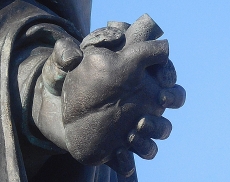
GRIPPING A HEART with the fingers of his left hand and his right hand on his chest, he stands in knee breeches, motionless on a plinth and staring out to sea. This bronze figure is a statue of the great scientist and first to give a scientific description of the way blood circulates through the heart and blood vessels, William Harvey (1578-1657), who was born in Folkestone, Kent, where his sculptural depiction stands. The commemorative artwork was created by the sculptor Albert Bruce-Joy (1842-1924) and made in 1881.

The heart in Harvey’s hand

Son of a Folkestone town official, William Harvey began his education in the town, where he learned Latin. Next, he attended The Kings School in nearby Canterbury before matriculating at Gonville and Caius College in Cambridge. After graduating in Cambridge in 1597, he enrolled at the University of Padua in northern Italy. There, he graduated as a Doctor of Medicine in 1602. Harvey became a physician at London’s St Bartholomew Hospital, and later (1615) became a lecturer in anatomy. In addition to his teaching activities, he became appointed Physician Extraordinary to King James I. It was in 1628 that he published his treatise, “De Motu Cordis”, on the circulation of the blood, work that remains unchallenged to this day. In 1632, he became Physician in Ordinary to the ill-fated King Charles I. In 1645, when Oxford, the Royalist capital during the Civil War, fell to the Parliamentarians, Harvey, by now Warden of Oxford’s Merton College, gradually retired from his public duties. He died at Roehampton near London and was buried in St. Andrew’s Church in Hempstead, Essex.

Folkestone, formerly a busy seaport, has restyled itself during the last few years. It has become a hub for the creative arts. Works by various contemporary artists, some quite well-known including, for example, Cornelia parker, Yoko Ono, and Antony Gormley, are dotted around the town and can be viewed throughout the year. Every three years, even more art can be found all over the town as part of The Creative Folkestone Triennial. This year, 2021, it runs from the 22nd of July until the 2nd of November. As one wanders around the town, one can spot artworks in both obvious locations and some less easily discoverable places. This year, the London based artistic couple Gilbert and George have exhibited several of their colourful and often thought-provoking images. And this brings me back to William Harvey.

High on a wall just a few yards behind the statue of Harvey, there are two images by Gilbert and George. Both were created in 1998. One is titled “Blood City” and the other “Blood Road”. Both relate to blood, its corpuscles, and its flow. It is extremely apt that they have been placed close to the image of the man who did so much to increase our understanding of blood and its circulation through the human body.