
Marilyn, Mao, and more at Milton Keynes

ONCE AGAIN, THE MK Gallery at Milton Keynes has put on a superb exhibition. Until 29 June 2025, there is a show of artworks by the artist and film maker Andy Warhol (1928-1987), who was born in the USA. Best known for his multiple portraits of figures such as Marilyn Monroe and Mao Tse Tung and Pop Art images, there is much more than this on display at the MK.

The first room of the show contains work that Warhol created in the 1950s and early 1960s. Like artists such as Picasso and Hockney, whose creative lives began with works that were not as experimental and novel as their later works, Warhol’s earlier, less revolutionary, images show that he was a competent draughtsman capable of producing highly acceptable ‘straightforward’ compositions. It was interesting to see his earlier works because they are rarely displayed in public galleries. And it is always nice to see how an artist who is best known for his or her more extraordinary creations began his or her creative output.

The exhibition includes many of Warhol’s Pop Art images including those of Marilyn and Mao, but also there are several of his portraits of other figures. These include the artist Basquiat, the politician Barry Goldwater, Marcel Duchamp, Joseph Beuys, Muhammad Ali, and Liz Taylor. What I found interesting was that amongst the portraits on display, there were a few of the British artistic couple Gilbert and George. As the exhibition booklet related:

“The British artistic duo Gilbert and George , like Warhol, explored the interplay between personal and public identity, often blurring the lines between performance and art.”

Warhol’s portraits of this couple reflect their own graphic artistic style.

Other images on display relate to the Cold War and to the electric chair. The images on display in the show include drawings, prints, posters, and photographs (often adjusted to create interesting artistic effects). There are also exhibits relating to Warhol’s prolific output of films. He made about 600 of them. It would have been interesting to have been able to see extracts from some of them.

In brief, this is an exhibition that is worth travelling to. Apart from being beautifully displayed alongside helpful information panels, it is worthy of a visit to be able to enjoy seeing this artist’s rarely seen early works.
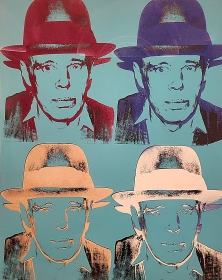
Repetitions of an image need not necessarily be monotonous

IF I WERE to tell you that I have just seen an exhibition of well over fifty photographic portraits of one person, all reproduced from the same original print, and enjoyed it, you might begin to wonder about me and my sense of aesthetics. Well, I really did enjoy this exhibition at the Thaddeus Ropac gallery in London’s Mayfair. If you wish to share the experience, you will have to hurry, because the show ends on the 9th of February 2024.

On or soon after the 30th of October 1979, the German artist and political activist (e.g., a co-founder of the German Green Party) Joseph Beuys (1921-1986), who was in New York City for the installation of a retrospective exhibition of his works at the Guggenheim Museum, was taken to meet the American Pop artist Andy Warhol (1928-1987). During that encounter, Warhol used his Polaroid camera to make a portrait of Beuys wearing his characteristic felt hat. It was not the first time that Warhol had photographed Beuys. He had also used his Polaroid when he first met Beuys earlier in 1979 at the Hans Mayer gallery in Düsseldorf (Germany). This meeting has been recorded on film (see https://youtu.be/PRrC8EJ3KxI?si=DM4RoR9nDrX_cJbX).

Between 1980 and 1986, Warhol used his Polaroid photograph of Beuys as the source image for a series of screen-printed portraits. As the Press Release on the website of the Thaddeus Ropac Gallery explained:

Repeating Beuys’s arresting gaze on different scales and in different formats, Warhol exercised his characteristically experimental approach to materials in the portraits. Amongst the paintings, unique Trial Proofs, line drawings, and unique and editioned works on paper, are examples of some of the artist’s earliest uses of diamond dust in portraits. These sit alongside images that have had their tonal values inverted to give the effect of photographic negatives. Belonging to the Reversal Series in which Warhol reproduced key subjects from across his wide-reaching body of work – including his iconic portraits of Marilyn Monroe, the Mona Lisa and Mao …”

In the 1940s, Warhol began his working life in commercial and advertising art. By the 1950s, he had discovered the secret of repeating images making small changes to produce variations on a theme. In 1952, he had his first solo exhibition in an art gallery (in NYC). Although it was not well received, it was not long before he became recognised as an artist of note. In 1962, he learned screen-printing techniques, and became one of the first artists to use this process for creating artworks. These include most of  the images on display at Thaddeus Ropac.

The results, which we were able to see at the gallery were far from monotonous, despite being repetitions of the same photograph. By modifying the sizes, colouration, and many other aspects of the photographic portrait, Warhol managed to bring a considerable degree of liveliness to this image. As I saw the various diverse presentations of the single image of Beuys, the German artist began to feel oddly familiar. It was almost as if I was meeting an old friend.

Before seeing the exhibition, I had my doubts about viewing what I had heard were multiple reproductions of the same photograph. My worries were dispelled within a few seconds of looking at the exhibition. I was fascinated how one image could be altered in so many different ways and the effect that seeing the results had on me, There are now less than 24 hours left before the show ends. So, if you can, hurry up and view it.