
An ambassador from England in Ajmer

AFTER MANY FRUSTRATING months of waiting and much travelling to follow him from place to place, the English diplomat Thomas Roe (c 1581 – 1644) finally got an audience with the Mughal Emperor Jahangir. Roe had been sent to India by King James I to establish a formal trading relationship.

Roe meeting Jahangir

 The meeting took place in the Mughal fort in Ajmer in 1618. At first, he had to communicate with the Emperor from outside the fort. Eventually, he was granted an audience with Jahangir within the fort. The meeting took place in the Diwan-i-Khas, the structure within the fort, where audiences were granted to important persons. The result of Roe’s meetings with Jahangir was an agreement that the British East India Company would have exclusive rights to establish factories (trading establishments) in Surat and other places.

 Yesterday (30th November 2024), we visited the Diwan-i-Khas in which Roe had discussions with Jahangir. The fort is well-preserved and now serves as a museum. The rooms in the fort house collections of sculptures, coins  paintings, inscriptions, weapons, and textiles. The museum is simply laid out, and the exhibits are lit well.

It was curiously moving to visit the place in which Roe met Jahangir. I am not sure why we felt that way, but maybe it was because we had previously read about Thomas Roe and his exploits in India.

A cook from Kutch in Norway

THE SHARAD BAUG HOMESTAY is in the extensive, luxuriant, verdant grounds of the Sharad Baug Palace. Badly damaged in the 2001 earthquake, the palace is a short walk from the excellent homestay. This accommodation is owned and run by members of the royal family of the former Kingdom of Kutch.

Close to the homestay in the middle of a field, there is another ruined edifice. This was formerly used as a guesthouse by important guests of the ruler, the Maharao. For some time, the poet Dara Shiko (1615-1659) hid from his brother (the future emperor Aurangzeb) in this building.

Near the ruined palace, there is a building, which was the last Maharao of Kutch’s sitting room and dining hall. Now, the building houses a small museum filled with exhibits relating to the royal Jadeja family. Amongst these, there are several items connected with the last ruler of independent Kutch when he spent some time in Norway.

After Kutch had joined India soon after 1947, its last Maharao, Madansinhji (1909-1991), was appointed India’s ambassador to Norway. There are photographs relating to his stay in Norway in the museum. There is also a Christmas card in Norwegian and a certificate issued by the Oslo Tennis Club. He served in Norway between 1957 and 1960.

While in Norway, Madansinhji was served by his chef from Bhuj, a member of the Yadav family. For many generations, the Yadavs have been chefs, specialising in non-veg food.

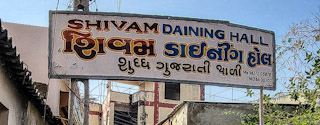
When we first visited Bhuj, in 2018, we were recommended to eat in a simple, small restaurant in the bazaar of Bhuj. Named Shivam Daining (sic), it serves very tasty pure vegetarian food. We returned to eat there several times during our recent (January 2023) stay in Bhuj. While chatting with its chef and his relatives, we learned that the man who produces the excellent food is a grandson of the Mr Yadav, who cooked for Madansinhji in Norway. Although the family have a tradition of cooking meat and fish, they do not offer it at Shivams because they rightly feel that there is little demand for non-veg food in the mainly vegetarian city of Bhuj.

Without knowing it when I booked the Sharad Baug homestay, it turned out that it and one of our favourite restaurants in Bhuj had at least one common connection, and that is Norway.