
ALI PASHA OF TEPELENE (1740-1822) was born an Albanian in what is now Albania. He ruled the Ottoman pashalik of Yanina (Ioannina in Greek) with a large degree of autonomy. One of his descendants was Naciye Hanim. She married Lieutenant Colonel Abdurrahman Ziya Bey,
Naciye and her husband had only one child, a daughter called Melek, who was born in 1896 (in Istanbul) and died in 1976 ( in Munich, Germany). She became a renowned painter, sculptor, and writer (books and articles). I would not have heard of her had we not visited the magnificent Sakip Sabanci museum of art at the village of Emirgan on the European shore of the Bosphorus. At this place there was an excellent exhibition of Melek’s life and works. With information both in Turkish and English, it was an enlightening experience.
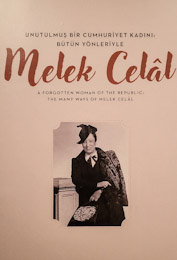
From an early age, Melek showed signs of artistic ability. She was brought up in an intellectual atmosphere. The Turkish poet Niğar Hanim encouraged her to take up painting. Her first lessons were with her uncle the soldier and painter Kâzim Bey. Later, she attended the Académie Julian in Paris. She also attended the School of Fine Arts for Women in Istanbul. While in Paris, Melek worked with various well-known French artists in their studios. Soon, she was recognised as an accomplished artist. This is evident from the many portraits and still-life’s on display in the exhibition.
In addition to painting and sculpting, Melek was a prolific writer of articles and books. She was also involved ed with Turkish politics during the period when the Ottoman Empire was dying and Ataturk’s modern Turkey was in its infancy. Her first book was published in 1938. In 1959, she published a book in French to introduce western readers to the delights of the Topkapi Palace complex in Istanbul. Many of her publications are on display alongside her paintings and one sculpture.
Melek married twice. First with Mr Celal in 1917. They had a son, and Celal died soon after that. In 1956, she married Dr Lampé, a physician. He died before she did. Melek died whilst being treated in a hospital in Munich.
Melek was one noteworthy descendant of Ali Paşa of Tepelene. There were others, who became famous Turkish intellectuals, including the writer Ebüzziya Tevfik(1849-1913), another writer Abdülhak Şinasi Hisar (1887-1963) and the author and poet Nâmik Kemal (1840-1888). These people of Albanian descent were not alone in shaping Turkey – both Ottoman and modern – in various ways, both peaceful and otherwise. I had heard about some of them, but Melek and her art are a wonderful discovery.
 yamey
yamey 