
The Garden City and Garden Suburb movements flourished in the last decades of the nineteenth century and the first couple of decades of the twentieth. I was brought up in London’s Hampstead Garden Suburb, whose construction began in 1907. My family home was built in 1908. I have written about the Suburb in my book “GOLDERS GREEN & HAMPSTEAD GARDEN SUBURB: VISIONS OF ARCADIA”. Because of my interest in garden suburbs, I decided to visit the Wekerle Estate in Budapest.
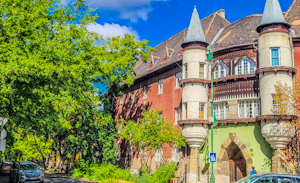
The leafy Wekerle Estate – Wekelertelep in Hungarian – was named after a former Prime Minister Sándor Wekerle, who who favoured the idea of building comfortable, human-scale housing estates for government employees. The estate was inspired by the ideas of Ebenezer Howard, the ‘father’ of the idea of Garden Cities.
Construction of the Wekelertelep began in 1908 and continued until 1925. The estate is built around a large central square, which contains a park, and roads radiate out from it in 8 directions. The buildings in the estate range from one to four or five storeys. Many trees and garden plots give the estate a leafy, open feeling. The architecture of the buildings is picturesque. It includes many features of Transylvanian vernacular styles. The buildings surrounding the central square are the ‘stars’ of the show. They include two gateways that differ in design. These and the edifices around the square, which vary in appearance, were designed by Károly Kós (1883-1977), who was born in what is now Romanian territory. He was not only an architect, but also a writer, a politician both in Hungary and Romania, and an ethnologist.
The Wekelertelep has 4 schools. By chance, we chatted briefly with the great-grandaughter of the first principal of one of them. She told us that 4 generations of his family have lived on the estate.
Another person whom we met was a sweet old lady – the caretaker of the Wekerle Worker’s St. Joseph Church. Very kindly, she unlocked the large neo-Romanesque Roman Catholic church for us. Designed by Bela Heintz, it was constructed between 1926 and 1930. Its spacious interior is decorated with many frescoes depicting scenes from the life of Christ. The caretaker – a tiny lady – guided us around inside the church, carefully explaining the numerous religious paintings, sculptures, and stainedglass windows to us in Hungarian, a language I barely understand. She was thorough. She did not want us to miss a thing. At the end of the tour, she sweetly hugged and kissed each of us.
This church, like the two main churches in Hampstead Garden Suburb, is next to the central square. However, unlike Hampstead Garden Suburb in which its founder Henrietta Barnett forbade the presence of shops, restaurants, pubs, and so on, the square in Wekelertelep has shops, cafés, and restaurants. The absence of such communal facilities renders Hampstead Garden Suburb’s central square a rather desolate, soulless place. In contrast, the square in Wekelertelep with its pleasant park and commercial establishments adds to the liveliness and vibrancy of this pleasant suburb.
I am very glad we trekked out of the centre of Budapest to view Wekelertelep not only because I wanted to see how it compares with Hampstead Garden Suburb but also it turned out to be one of Budapest’s delightful surprises.

