
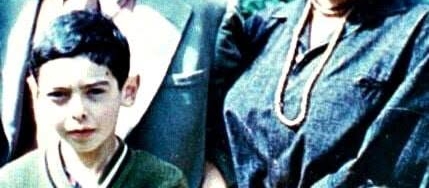
I WAS BORN in the early 1950s, just over 50 years after Queen Victoria died. In those early years of my childhood, London still had a network of trolleybus lines. One of these routes ran along Finchley Road in the Golders Green district of northwest London. Trolleybuses used to run past my co-educational primary school, which was located on the corner of Finchley Road and Middleton Road. Called Golders Hill School and founded in 1908, I attended it from 1956 until 1960. During my time at the school, its headmistress was Miss Davies, a spinster who used to cycle to the school from her home in Highgate every day. She used to be accompanied by her two corgi dogs, who travelled in a wicker basket attached to the front of her bicycle. The rest of the teaching staff were also women, amongst whom Mrs Fitzgerald was a formidable personality. The school had high academic standards, and many of its pupils continued their education in academically prestigious schools after passing their eighth birthdays. We began learning French when we were 7 years old, and if one made it to the top class,which I did not, Latin was also taught.
The day started with assembly and taking the register. We stood in rows facing a photograph of the Matterhorn, while our names were read out. When you heard your name, you had to answer in Latin with the word ‘adsum’. Following the rollcall, we recited The Lords Prayer at great speed. It sounded like mumble-jumble to me, and it was only many years after leaving the school that I realised what we were reciting. Interestingly, although almost half the pupils were Jewish, they were expected to join in spouting out the Christian prayer. During Jewish holidays, there were many pupils absent from the classes. The school was quite old-fashioned. Its teachers would have been brought up in the early part of the twentieth century, and did not have modern or ‘progressive’ ideas, such as was the case at another school in Golders Green – King Alfred’s, where pupils addressed their teachers by their first names and free expression was encouraged.
We ate lunch at the school. Groups of pupils sat around long rectangular tables. The children on the table that finished their entire lunch fastest were rewarded. The prize was a small piece of sugary, melt-in-the-mouth confectionery from a box of Dolly Mixture (first produced in the 1920s). After finishing their meals, the children were allowed to play outside in the playground area attached to the school.
In my childhood I was an incredibly fussy eater. There were only a few things I was prepared to eat. None of these items were ever served at Golders Hill School. Although it might sound ungrateful, nothing, apart from the school’s steam pudding, appealed to me. The food seemed nightmarishly disgusting. Therefore, I was classed as a ‘slow eater’, and forced to sit at the ‘slow table’. This seated four children. I was the only boy. One of the girls was called Rhoda. I remember this because it was a name I had never come across in my then short life.
We had to remain at the slow table with our unfinished food, by now quite cold, on the plates in front of us. Whilst we sat at this table, we could look through the nearby window and see all the other children playing outside. Pointlessly, I used to shift the food around my plate hoping it would disappear, but it did not. In desperation, I would put the unfinished food into the pockets of my short trousers, and then visit the toilet. There, I entered a cubicle, and emptied the contents of my pockets into the toilet bowl. Curiously, my mother who washed my clothes, never remarked on the state of my pockets that had contained unwanted luncheon.
One day, I was defeated by a dish. It was gooseberries, which I hated, in custard. I could not bring myself to fill my pockets with the contents of the dish. Because of this, suddenly my life felt hopeless. I decided that I would carry the dish to the door of the staff room, and hoped that someone would give me permission to abandon it. Full of apprehension and fearing the wrath of the teachers, I knocked on the door. It was opened by one of the younger looking teachers, Miss Dredge. As soon the door opened, my hands must have moved – I might have been trembling – and the bowl with its contents fell at her feet. Miraculously, nothing adverse happened to me, and I was not made to eat any more.
I often wonder whether dropping the gooseberries and custard was an unfortunate accident or, possibly, an act of rebellion on my part.
PS: Many years have elapsed since the dessert slipped out of my hand. Now, I love eating gooseberries, especially gooseberry fool, but sadly they are rarely available in shops in London.

