
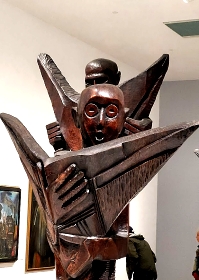
SEVEN CARVED WOODEN figures stand in a line at an exhibition in London’s Tate Modern gallery. Each of them is depicted holding something that looks like an book or a pair of wings. Their faces are all different, as are their expressions and heights. They were carved by the Nigerian artist Ben Enwonwu (1917-1994), and form part of a superb exhibition, “Nigerian Modernism”, which is showing until 10 May 2026.
Ben Enwonwu was born in Nigeria. His father was a traditional sculptor. Ben studied art first at Government College in Ibadan (Nigeria), and then at Government College Umuahia. At both places, he studied art under Kenneth Murray (1902-1972). In 1944, Ben was awarded a scholarship that allowed him to study both at The Slade School of Art in London and at The Ruskin School in Oxford. Also he undertook postgraduate studies in West African anthropology at the University of London. Thereafter, he taught art in Nigeria, where he created many of his sculptures and paintings. Since completing his education, Enwonwu has received international acclaim for his work.
In 1960, Ben proposed making a sculpture to commemorate Queen Elizabeth II’s visit to Nigeria in 1956. It was to be placed in the Nigerian House of Representatives in preparation for Nigeria’s independence in 1960. At the Tate’s exhibition, there is a photograph of Enwonwu working on this sculpture in the studio of his friend, the sculptor William Reid Dick (1878-1961), who was Sculptor in Ordinary for Scotland to Queen Elizabeth. At around this time, Ben received another commission in England.
The British newspaper, the Daily Mirror, commissioned Ben to create 7 sculptures for their headquarters. Carved in ebony, these are the works mentioned above. The diversity of their forms and expressions is supposed to represent the variety of people reading thepaper. According to a label in the exhibition, Enwonwu said:
“I tried … to represent the wings of the Daily Mirror, flying news all over the world.”
The statues were placed in the headquarters public courtyard in Holborn. Currently, they are in the Tate Modern, but after having been lost for several years, they were sold at public auction. They are now owned by Access Holdings PLC, a Nigerian company.
In addition to what I have already described, there are many more works by Enwonwu in the exhibition, both paintings and sculptures. Each one of them is wonderful. His works show the influence of European Modernism, but at the same time they reflect the artist’s African background and his involvement in the traditional art of his homeland. He was sympathetic to the Négritude movement, an anti-colonial cultural and political movement founded by African and Caribbean students in Paris in the 1930s, but was also affected by twentieth century artistic movements in Europe and the USA. It was fascinating to see how the modern art trends of the mid-twentieth century were successfully integrated with the artist’s desire to portray the life and traditions of Africa.
 yamey
yamey 