
Inside St Bartholomew the Great, London
In this stone font
Was William Hogarth baptised
Artist of great fame

Inside St Bartholomew the Great, London
In this stone font
Was William Hogarth baptised
Artist of great fame
ST BARTHOLOMEW THE GREAT church in the City of London was founded in 1123 by Rahere, a courtier of King Henry the 1st, who reigned from 1100 to 1135. It was originally built as the church for an Augustinian priory, which was abolished and partly destroyed during the reign of King Henry VIII. When this happened (in 1539), the priory church’s nave was demolished, leaving only the apse and beyond it, the Lady Chapel. The choir, which used to be at the west end of the apse and at the eastern end of the demolished nave, now stands at the east end of what is now the nave, but was formerly the apse. The current nave (formerly the apse of the original church) is a magnificent example of Norman architecture. I could go on describing this magnificent church in great detail, but I will not because plenty of people have done it before me (e.g., https://en.wikipedia.org/wiki/St_Bartholomew-the-Great and https://medievallondon.ace.fordham.edu/exhibits/show/medieval-london-sites/stbartsgreatchurch). Instead, I will mention a couple of the many interesting items in the church that caught my interest during a visit today (the 2nd of April 2024).
Both the objects of interest stand in the southwest corner of the church, close to the entrance that leads to the path that runs along the location of the long-since demolished apse of the priory church. The two things stand a few feet from each other. One of them is a carved stone font, said to be one of the two oldest fonts in London – the other being in the parish church of St Dunstan & All Saints in Stepney. What interested me about St Bartholomew’s font, which is still in use, is that it was here that the painter William Hogarth (1697-1764) was baptised. He had been born in a house in Bartholomew Close near the church in the Smithfield district of London.

Hogarth was a successful artist in his time, and has become recognised as one of the famous British artists of the 18th century. Not far from the font, there is a dramatic gold coloured sculpture by one of the most famous British artists of our times – Damien Hirst (born 1965). The sculpture, which is on loan from the artist, is called “Exquisite Pain.” It is Hirst’s depiction of St Bartholomew holding his skin, having been flayed. The church’s website (www.greatstbarts.com/visiting-us/artworks/damien-hirst-exquisite-pain/) revealed:
“St Bartholomew, one of the original twelve disciples, was sent as an Apostle to Armenia, where he was killed by being skinned alive. The classic iconography of the saint sees him naked, his muscles exposed, his skin hanging over his arm – and in his hands, the instruments of his torture. This statue sees Damien Hirst conform to this imagery, but give it a unique twist: the instrument in his hand is not a standard knife, but a scalpel, used in the hospital across the road which also bears the saint’s name.”
I think it is a wonderful sculpture. However, like most works of art, it might not suit everyone’s taste, but there is no doubting that its dramatic impact and skilful execution are remarkable.
While Hirst’s fame is great today, and his works command high prices, I wonder whether his reputation as a notable British artist will survive as long as Hogarth’s.
THE FOLLWING FIVE ROADS meet at West London’s busy Hogarth Roundabout: The Great West Road, Church Street, Burlington Lane, Hogarth Lane, and Dorchester Grove. Excepting Church Street, they are all major thoroughfares, which carry a great deal of traffic. The roundabout is named after the artist William Hogarth (1697-1764), whose former home, Hogarth’s House – now a museum, is close by.

The museum at Hogarth’s House contains a large collection of prints created by Hogarth. All of them illustrate 18th century life in Britain in exceptional detail. The artist did not portray scenes straightforwardly. He portrayed the people and what they were doing in a satirical – sometimes comical – way. So, that what we see today is not only how things looked in Hogarth’s time but also what he felt about them.
Amongst the prints on display, there is one created in 1997 by the cartoonist Martin Rowson (born 1959). It depicts the chaos, dirt, and traffic at Hogarth Roundabout as Hogarth might have done had he been alive to see it. This entertaining print, which was made to commemorate Hogarth’s 300th birth anniversary, includes details copied from Hogarth’s prints. It is a fascinating addition to the collection of the small museum.
I AM READING A most fascinating book at present (June 2023). Published in 1984, it is “Staying Power: The History of Black People in Britain” by Peter Fryer (1927-2006). In it, the author described how during the 18th century, it was fashionable for wealthy British people living in England to have at least one ‘black’ servant (or slave, in some cases) amongst their teams of domestic staff. Including a black servant in a portrait painting was believed to add to the perceived status of the subject being portrayed. Putting it crudely, just as sporting a Prada handbag or driving a Maserati is supposed to enhance the status of their owners today, exhibiting the ‘black’ servant did the same for the vanity of the wealthy in the 18th century. Sadly, many wealthy British people in the 18th century did not see the ‘black’ servants as human beings but as valued possessions or accessories.
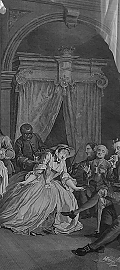
Today (3rd of June 2023), we paid a visit to Hogarth’s House in Chiswick. Located next to the busy A4 dual carriageway and the often-congested Hogarth Roundabout, it is now hard to believe that in 1749, the artist William Hogarth (1697-1764) bought this place to use as his country home. For, in those days this 17th century house was surrounded by countryside. The house and its garden are open to the public free of charge. The visitor gets to see a series of wood-panelled rooms, very much like those I have seen a friend’s 18th century house in the oldest street in Kensington. Unlike our friend’s house, the walls of the rooms of Hogarth’s former country place are lined with a large number the artist’s wonderful, printed works. Most of these depict scenes portrayed with many fine details. They express Hogarth’s satirical views of the life and behaviour of his contemporaries.
Some of the prints portray the lives of the poor and less well-off. A few depict life in ‘high society’. In several of the latter, there are a few black faces amongst the people in the pictures. All of them are obviously servants. In one of these prints, a black woman with her back facing the viewer can be seen attending to something at her white mistress’s foot. The lady is reclining, and she is looking up from a book propped in front of her. In another print, a black man is shown carrying a cup and saucer into the room filled with white people and there is also a black child playing with a small statue or toy. I examined all the prints on display and noticed that it was only those with scenes of the lives of rich people that included black people. The people in all the other prints were white only.
The depiction of black people with rich people in Hogarth’s satirical depictions of life in 18th century England helps to back up what I have read so far in Fryer’s book. That said, and I might not have noticed what I have described had I not been reading the book, Hogarth’s House is a delightful place to visit. It does not offer refreshments but the lovely café at Chiswick House is only a few minutes’ walk away.
 yamey
yamey 