
A CAFE, A PUBLIC TOILET, A CHURCH, AND A MOSQUE IN ISTANBUL

I NEEDED NEW shoes today (20th April 2024). After buying a pair in the superbly stocked Fast Step shoe shop, we felt the need for coffee. Near the shop, we found a café called Gutta. Having enjoyed good coffees – both Turkish style and Italian style, we needed to answer the call of nature.

We asked if the café had a toilet. It did not, but, as has happened frequently in Istanbul, we were directed to the nearest mosque. This mosque, like others in Istanbul, has public toilets, for which in this case a modest charge was levied. As with most WCs in Istanbul, this one was well-maintained.

Kalenderhane Mosque

The mosque in this case is called the Kalenderhane Mosque. Its name derives from the Kalender dervishes, who once used it as a ‘tekke’. From the outside it looks remarkably like a very old Greek Orthodox church. It was converted for the use of the dervishes by Sultan Mehmet (the Conqueror) in 1453. In the 18th century, it was converted into a mosque.

Built in about the 9th to 10th century next to the Aqueduct of Valens , it is now thought to have been dedicated to Theotikos Kyriotissa. Sadly, as it was locked up, we were unable to enter the edifice.

Had it not been for nature’s call, we might not have come across this interesting mosque. As is the case for many old mosques in Istanbul, it is a fine example of Ottoman repurposing existing Christian buildings in the 15th century.
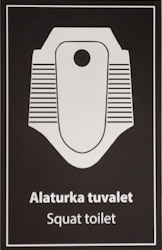
A toilet in the airport of Istanbul

I FIRST VISITED Turkey in the early 1960s. It was then that our family first came across squatting toilets. For want of a better name, we called these hole in the floor lavatories ‘Turkish loos’.

Today, in April 2024, we landed at Istanbul’s vast new airport. As nature was calling, I visited one of the many toilets in the airport building. You can imagine my surprise and satisfaction when I saw on the door to a cubicle containing a squatting toilet a sign that read in Turkish “Alaturka tuvalet”, and beneath it, the English words “Squat toilet”. So, it seems that we were right to christen these types of toilets ‘Turkish loos’.

Relief below ground

IT IS NOT OFTEN that I feel the need to write about answering the call of nature but after a recent visit to Hampstead’s South End Green, I must satisfy the urge.

There is a yard at South End Green, where buses serving the route number 24 wait before setting off to Victoria station. Long ago, this yard used to have tram tracks as it was the terminus of a tram line. A lovely small café, Matchbox by name, stands beside the yard. Its owner, Mirko, a friendly Slovenian, serves excellent hot beverages and a range of mouth-watering snacks, both sweet and savoury. The nearest public toilets are across the yard, almost opposite to Matchbox.

The toilets are below ground level and accessed by staircases with cast-iron structures above them. It was only on our most recent visit to South End Green, in December 2021, that I had reason to descend into the ‘gents’, and I am pleased that I did, not only for reasons related to my physiology but also to satisfy my curiosity.

The ‘gents’ is magnificent, with its white glazed brick walls decorated with bands of light green bricks, its long narrow, black and white chequered floor, its polished dark wood cubicles, and its row of white urinals all topped with grey (marbled with white streaks) granite separators. Although there is electric lighting, a skylight admits some natural light.

The underground toilet facilities, both the men’s and the ladies’, were constructed in 1897 for the benefit of passengers using the tramway. Stephen Emms, writing in the “Kentish Towner” in October 2013, noted that the gent’s underground facility at South End Green was a pick-up place used by homosexuals. He noted:

“But most memorably South End Green is the only public toilet still in use known to have been visited by iconic 1960s playwright Joe Orton. Apparently it was his “favourite pick-up point” too””

You might be relieved to learn that my recent brief visit was completely uneventful.