
Dali and Dante in London’s Bermondsey Street

EAMES FINE ART Gallery is in south London’s Bermondsey Street. It specialises in original prints and paintings by Modern and contemporary masters. Whenever we are in Bermondsey Street (usually to visit the White Cube Gallery and the wonderful Vietnamese eatery called Caphe House), we take a look at what is being shown at Eames. Until 18 May 2025, they are showing a collection of wood engravings that the surrealist artist Salvador Dali (1904-1989) first created as watercolours before supervising their transfer onto woodblocks to make prints based on these paintings.

In 1950, the Italian government commissioned Dali to produce a set of images to illustrate the “Divine Comedy”, which was composed by Dante Aligheri (c1265-1321) between about 1308 and 1321 AD. Dante’s work is one of the treasures of Italian literature, and the commissioning of Dali, who was not an Italian, was so controversial that it was debated in the Italian Parliament, after which Dali’s contract was cancelled. As the gallery’s website notes:

“Undeterred, Dalí, with the help of the French publisher Joseph Forêt, decided to complete the project himself and produced 100 sumptuous watercolours in a searing evocation of Heaven, Hell and Purgatory in response to Dante’s text..”

It was these watercolours that were transformed, under Dali’s supervision, into the prints, which are currently on display at Eames. I was interested to see them because usually the only works by Dali that I have seen have been his oil paintings. The images that have been created from these watercolours by Dali are more impressionistic and freer in form than the almost crystal clarity of the images in his oil paintings. I am pleased that we took a look inside Eames. We had no idea that they were showing such an interesting collection of works.
Tanning at the Tate Modern


One of the great features of possessing a Tate Card (an annual season ticket) is that one can enter (with or without a companion) the regular special exhibitions without paying extra for tickets, which tend to be quite costly. What I particularly like is that if an exhibition does not meet one’s expectations, one can spend a short time viewing without worrying about having wasted, maybe, as much as £18 per person.

Recently, I visited the much-hyped special exhibition of works by the French painter Pierre Bonnard (1867-1947) at the Tate Modern in London. Without the Tate Card, the two of us would have had to shell out £36 (about 30% of the cost of a Tate Card) to see what I thought was a tedious exhibition. 

I like Impressionist and Post-Impressionist art in general, but the Bonnard works left me cold (or at least lukewarm!). I cannot comment on the competence of their execution, but I found them short of visual excitement, almost boring compared with works of other artists painting during Bonnard’s lifetime. Consequently, we did not linger long in the exhibition. I may sound like a Philistine with my comments about the famous Bonnard, but it is only fair to write honestly about how the exhibition affected me. Incidentally, I noticed that many of the visitors at this show were more interested in chatting to each other than looking at Bonnard’s works. I saw one man sitting on a bench reading his newspaper rather than trying to enjoy Bonnard.

As we were still in the mood for looking at art, we decided to enter another special exhibition in the Tate Modern. Using our Tate Card, we saved up to £26 when we entered the exhibition of artworks by the American-born Dorothea Tanning (1910-2012). However, this is an exhibition that is well worth its entrance fee. Bonnard and Tanning’s working lives overlapped for a few years, but the American’s output made a far greater impression on me than the Frenchman’s. 

The exhibition at the Tate Modern commences with paintings from Tanning’s surrealist phase. Her execution and composition sets her amongst the best of the surrealist artists. Each painting has subtlety, excitement,  a sense of adventure, and creative freshness. As Tanning grew older, her works tended towards abstraction in an original way. In brief, Tanning was an artist whose visual language(s) really attract me. Her work has a freshness and impact that I found lacking in Bonnard.

In addition to paintings and designs for stage sets, the exhibition at the Tate includes some of rather weird soft fabric sculptures, which did not appeal to me quite as much as the framed works. However, they display another aspect of Tanning’s undoubted inventive talent.

I am glad we decided to visit the Bonnard, even though it disappointed me, because it got me to visit the Tate Modern after a long break (in India) and to discover the delights of Dorothea Tanning’s  artistic output.


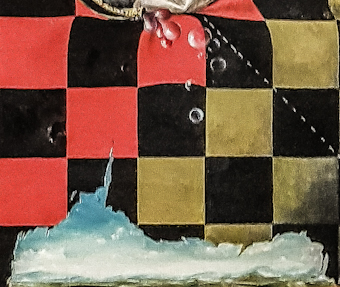
The photo is a detail of a work, “Endgame” , painted by Dorothea Tanning in 1944