
Raise your eyes in this church in central London

THE STRAND IS a street in the heart of London, which runs close to the River Thames. It used to be close to the water. Hence, its name. Two churches stand like islands in this busy thoroughfare. One of them is St Clement Danes, and to the west of that is St Mary Le Strand, which we entered today (the 17th of May 2024) after visiting the Photo London exhibition at nearby Somerset House.

St Mary Le Strand was designed by James Gibbs (1682-1754) and constructed between 1714 and 1717. It was built on the site of a great maypole, which was the centre of May Day celebrations in the 16th and 17th centuries. The church’s interior is in an exuberant baroque style, reflecting its architect’s earlier travels and training in Italy.
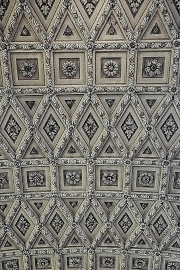
The walls of the nave are bare. It had been intended to have been painted, but this never happened. What really attracts the eye is the amazing geometric ceiling above the nave (see photograph). The ceiling is an expanse of triangles, squares, and lozenges that cover its barrel vaulting. In the centre of each of these many shapes, there is a sculpted flower. This ceiling was designed by Chrysostom Wilkins, who worked on other churches in London. It was created in plasterwork, shaped by hand, without using moulds.

St Mary Le Strand has been open less regularly than its neighbour St Clement Danes. Although I have visited the latter often, I believe that today was either the first or one of a very few visits to St Mary Le Strand. If you happen to be passing this church, and it is open, do take a few minutes to admire its wonderful ceiling.

Burgers on the Strand

THE BYRON RESTAURANT chain, which specialises in serving burgers, has a branch next to the Adelphi Theatre on London’s Strand. I have not eaten there but I did peer through its street door. What I saw is quite amazing. The ground floor dining room’s walls have giant mirrors separated by marble pilasters. The ceiling beams look like marble , although it is unlikely that they are made of that material. The grand dining room has a decadent fin-de-siècle appearance, providing your eyes are averted from the banquettes upholstered with red leather, or perhaps plastic, which are quite appropriate for a burger joint.

The large façade of the restaurant has pink granite pillars on both sides. On one of these, there is a commemorative plaque that reads:

“Site of the Adelphi Theatre Restaurant owned by the Swiss-Italian Gatti family, restaurateurs, music hall, theatre and electricity supply entrepreneurs. Sir John Gatti served as Lord Mayor of Westminster, 1911-12.”

The Adelphi Theatre is still in business, but its neighbour, the Adelphi Theatre Restaurant, is now the Byron outlet.  Carlo Agostino Gatti (1841-1897) and his brother Stefano Gatti (1844-1906), father of Sir John, ran the Adelphi Theatre, the Adelphi Theatre Restaurant and the Vaudeville Theatre all in the Strand (www.londonremembers.com/subjects/gatti-family). Carlo and Stefano came from Ticino Canton in Switzerland. Another Gatti, Gaspare Antonio Pietro Gatti, known as ‘Luigi’, came to London from Montalto Pavese in Italy, where he was born in 1875. He is supposed to have managed the restaurant at The Ritz Hotel, as well its concessions on two ships, one of which was the ill-fated Titanic. Whether Luigi was related to the brothers is uncertain.

What is also uncertain in my mind is whether the dining room that now serves as home to Byron and its burgers is the original that existed when the Gatti family owned the restaurant or whether it is from a later era. The upper storeys of the building were recently converted into luxury flats, whose interiors can be viewed on websites such as https://www.businessinsider.com/pictures-london-gatti-house-millionaire-flats-on-the-strand-with-pizza-lift-2015-10?r=US&IR=T .

So, next time you are wandering along the Strand, take a peek into Byron’s and, maybe, if you are feeling peckish …