
I HAVE PASSED this Victorian gothic church many times while travelling on the 148 bus route northbound, but it was only today, 7 April 2026, that I first set foot in it. The church is, actually, a cathedral but not the Anglican Southwark Cathedral (near London Bridge). It is St George’s Cathedral, Southwark, a Roman Catholic church.
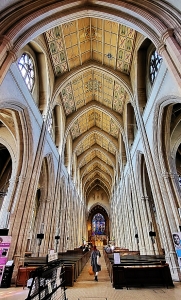
Opposite the Imperial War Museum, the cathedral was built in 1848. Although it is a Victorian gothic edifice, it has the feel (a spacious lightness) and appearance of churches built in mediaeval times. Maybe this should not be surprising when one learns that its first architect was Augustus Welby Northmore Pugin (1812-1852), one of the leading exponents of of Gothic Revival in Britain. Pugin converted to Catholicism in 1834, and this attracted him new patrons and commissions.
What we see today when entering the cathedral is not what Pugin would have seen. In WW2, the building was badly damaged by bombing. Within the external structure of Pugin’s building, the architect Romilly Craze (1892-1974), who restored many bombed churches, designed a gothic revival cathedral, which was opened in 1958, and that is what we see today.
Within the cathedral, one can admire the fine twentieth century stained glass windows, the circular shrine of Frances Xavier Cabrini (patron saint of migrants), the tomb of Peter Emmanuel Amigo (sixth Bishop of Southwark; lived 1864-1949), and a reclining sculpture of Provost Robert Doyle (1793-1879). Doyle was associated with the construction of the cathedral, and asking Pugin to design it. He was also involved with purchasing the land on which it was constructed.
Although it cannot compare with the great mediaeval cathedrals in England, St George’s is plasing to the eye, and judging by the large number of people joining a service on a Tuesday lunchtime, it serves its purpose well.
 yamey
yamey 