A back passage near to London’s Smithfield and Barbican

THE CITY OF LONDON has suffered many upheavals including, to mention but a few, the great Fire of London (1666), heavy bombing during WW2, and often overzealous redevelopments after 1945. Despite these major changes, remains of mediaeval London can still be found. One of these is close to the church of St Bartholomew the Great, which escaped being damaged during WW2, and has been standing since 1123. It was founded as part of an Augustinian priory that was dissolved by Henry VIII in 1543. Close to this fascinating church, and running in a straight line from east to west is the narrow East Passage.

This alleyway is about 80 yards long and lined with the rear facades of buildings – mostly not particularly old. Yet, East Passage has been in existence since the dissolution of the priory in the 16th  century (www.ianvisits.co.uk/articles/londons-alleys-east-passage-ec1-36703/). It is a thoroughfare developed on land that had belonged to the priory, and was sold to Sir Richard Rich (1496-1567), who was Lord Chancellor during the short reign of King Edward VI, successor to Henry VIII. East Passage was one of a new series of streets laid out soon after the priory was closed. As the author of the ianvisits.co.uk website pointed out, the group of small straight streets, of which East Passage is one, was one of the earliest planned developments in London (with straight rather than haphazardly arranged, curvy streets), predating the planned development of Covent Garden in the 17th century.

Today, East Passage is about half the length it used to be. Before it was known as East Passage, it was known as ‘Back Court’ or ‘Back Street’. At its west end, there is the rear of a pub called The Old Red Cow. It is one of the longest established pubs near to Smithfield meat market, although the building housing it looks as if it was built in the 19th century. Close to this hostelry, but not on East Passage, there is another pub, The Hand and Shears. Established in 1532, but housed in a more recent building, whose name reminds us that it used to be frequented by cloth merchants. A note in a website (https://darkestlondon.com/tag/old-red-cow/) mentioned that The Hand and Shears:

“… was used as the venue to settle disputes and grievances of people who visited the annual St Bartholomew’s Fair – licences were granted, weights and measures were tested, and fines imposed on fraudulent traders. For many years, the Fair was officially opened from the inn’s doorway by the Lord Mayor – but impatient clothiers would later wait at the pub the night before and declare it open on the stroke of midnight, signalling to gathering crowds that the Fair was officially open by waving a pair of shears in their hands.”

Possibly, I would not have noticed the slender East Passage had we not been sitting in a café nearby. I spotted it through the window of the Pret a Manger on Long Street that runs parallel to East Passage, and felt I had to explore it. As I walked along it, I had not idea that this small back passage had such a long history and would never have existed had Henry VIII not fallen out with the Pope in Rome.

A Dutch name on a gravestone in the City of London

AT THE OLD BAILEY court on the 18th of February 1767, Edward Wild was formally accused (indicted) of stealing 25 yards of woollen cloth worth £10 from the widow, Winifred Vanderplank (https://www.oldbaileyonline.org/record/17670218), and found guilty. At the trial, Winefred’s son Bartholomew Vanderplank told the court:

“I live in Bartholomew-close with my mother; I am a cloth-worker. Last Monday three weeks, the piece of cloth mentioned was taken away; the prisoner at the bar was stopped with it; I was before Justice Welch when he and the cloth was; he there confessed he took it away.”

According to “The records of St. Bartholomew’s priory and of the church and parish of St. Bartholomew the Great, West Smithfield” (publ. 1921), Mr Vanderplank lived close to the Church of St Bartholomew the Great, formerly part of the Priory that existed there until it was disbanded and partially demolished during the reign of King Henry VIII. The records stated:

“… The house of  Mr.  Vanderplank close by (he  lived  at  No.  54 [ i.e., Bartholomew Close])  was  the  monastery  kitchen  from  which  a  subterranean  passage communicated  with  the  church,  persons  having  passed  through  it to  the  knowledge  of  the  proprietor.”

The same records revealed that the Vanderplanks lived at 54 Bartholomew Close:

“In the London Directory  of  1770, No.  54 was in the occupation of the Vanderplanks,  cloth  workers, who  lived  in  the  parish  until  the  middle  of  the  nineteenth  century.”

You might be wondering why I should be telling you about a family whose surname indicates that it probably has Dutch origins. Well, the reason is that yesterday (the 2nd of April 2024), I was in the church of St Bartholomew the Great (near Smithfield Market) when I looked at the floor and spotted the gravestone recording the deaths of several members of the Vanderplank family, including that of Bartholomew, who appeared in court on the 18th of February 1767. 

Regarding Bartholomew, he was affiliated to the City of London’s Clothworker Company (guild) (https://londonroll.org/search), as were some other members of the family, who lived in Bartholomew Close. I have not yet been able to find out when exactly the Vanderplank family settled in England,  but I have read (www.ourmigrationstory.org.uk/oms/londons-evil-may-day-riots):

“The Flemish and Dutch arrived in England in large numbers in the fourteenth and fifteenth centuries and were primarily artisans, especially weavers and other cloth workers. This was partly due to ‘pull’ factors in the form of royal invitations and ‘letters of protection’ issued by the king. The Crown was keen to boost the English cloth industry by encouraging the arrival of skilled foreign workers. However, immigrants from the Low Countries also came due to ‘push’ factors, especially the hardships caused by warfare in the region and sentences of mass exile in the late fourteenth century for participating in revolts in Flanders.”

The top of the stone reads:

“Here lieth the Body of Barthow Vanderplank Late of the Parish who died July 19 1792 aged 48 years.”

The stone also commemorates the deaths of other members of his family – his wife and children. Because I was curious about the surname, I did a little research on the Internet, and found what I have just described.

William Hogarth and Damien Hirst as neighbours in a church in London

ST BARTHOLOMEW THE GREAT church in the City of London was founded in 1123 by Rahere, a courtier of King Henry the 1st, who reigned from 1100 to 1135. It was originally built as the church for an Augustinian priory, which was abolished and partly destroyed during the reign of King Henry VIII. When this happened (in 1539), the priory church’s nave was demolished, leaving only the apse and beyond it, the Lady Chapel. The choir, which used to be at the west end of the apse and at the eastern end of the demolished nave, now stands at the east end of what is now the nave, but was formerly the apse. The current nave (formerly the apse of the original church) is a magnificent example of Norman architecture. I could go on describing this magnificent church in great detail, but I will not because plenty of people have done it before me (e.g., https://en.wikipedia.org/wiki/St_Bartholomew-the-Great and https://medievallondon.ace.fordham.edu/exhibits/show/medieval-london-sites/stbartsgreatchurch). Instead, I will mention a couple of the many interesting items in the church that caught my interest during a visit today (the 2nd of April 2024).

Both the objects of interest stand in the southwest corner of the church, close to the entrance that leads to the path that runs along the location of the long-since demolished apse of the priory church. The two things stand a few feet from each other. One of them is a carved stone font, said to be one of the two oldest fonts in London – the other being in the parish church of St Dunstan & All Saints in Stepney. What interested me about St Bartholomew’s font, which is still in use, is that it was here that the painter William Hogarth (1697-1764) was baptised. He had been born in a house in Bartholomew Close near the church in the Smithfield district of London.

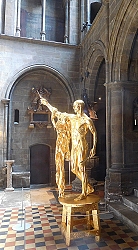
Hogarth was a successful artist in his time, and has become recognised as one of the famous British artists of the 18th century. Not far from the font, there is a dramatic gold coloured sculpture by one of the most famous British artists of our times – Damien Hirst (born 1965). The sculpture, which is on loan from the artist, is called “Exquisite Pain.” It is Hirst’s depiction of St Bartholomew holding his skin, having been flayed. The church’s website (www.greatstbarts.com/visiting-us/artworks/damien-hirst-exquisite-pain/) revealed:

“St Bartholomew, one of the original twelve disciples, was sent as an Apostle to Armenia, where he was killed by being skinned alive. The classic iconography of the saint sees him naked, his muscles exposed, his skin hanging over his arm – and in his hands, the instruments of his torture. This statue sees Damien Hirst conform to this imagery, but give it a unique twist: the instrument in his hand is not a standard knife, but a scalpel, used in the hospital across the road which also bears the saint’s name.”

I think it is a wonderful sculpture. However, like most works of art, it might not suit everyone’s taste, but there is no doubting that its dramatic impact and skilful execution are remarkable.

While Hirst’s fame is great today, and his works command high prices, I wonder whether his reputation as a notable British artist will survive as long as Hogarth’s.

Benjamin Franklin and Saint Bartholomew

ONE OF LONDON’S FEW remaining pre-1666 (Fire of London) buildings is the church of St Bartholomew the Great close to Smithfield Market. Founded in the 12th century, the building has many Norman (Romanesque) features. It also contains some contemporary artefacts including “Colloquy” (a work made from glass) by Sophie Arkette, and “St Bartholomew. Exquisite Pain” (a work in gilded bronze) by Damien Hirst.

By Damien Hirst

Beyond the chancel at the east end of the church there is the spacious Lady Chapel. During the Reformation (after about 1529), this part of the church was closed off from the rest of it, and used as commercial premises. In the 18th century, it was used as a printer’s workshop owned by Mr Palmer. Benjamin Franklin (1706-1790), one of the founding fathers of the USA, worked as an apprentice in this printing works in 1725. Then, he was lodging nearby in Little Britain. While he was working in the converted Lady Chapel, he wrote his philosophical pamphlet, “A Dissertation on Liberty and Necessity, Pleasure and Pain.” Franklin wrote:

“At Palmer’s I was employed in composing for the second edition of Wollaston’s “Religion of Nature.” Some of his reasonings not appearing to me well founded, I wrote a little metaphysical piece in which I made remarks on them. It was entitled “A Dissertation on Liberty and Necessity, Pleasure and Pain.” I inscribed it to my friend Ralph; I printed a small number. It occasion’d my being more consider’d by Mr. Palmer as a young man of some ingenuity, tho’ he seriously expostulated with me upon the principles of my pamphlet, which to him appear’d abominable.”

The workshop was purchased by the church and restored as a Lady Chapel in 1897. An information panel next to it provides its history and connection with the young Franklin. It was by pure chance that I came across this London link with the American Revolution on the 4th of July.