
Information for the servants of the house

NEXT TO THE KITCHEN in our family home in Hampstead Garden Suburb, there was a wood framed bell board. It consisted of a set of circular windows, each labelled with the name of a room in the house. There was an old bell button in my bedroom. If you pressed it, a pendulum hanging behind the circular window labelled for my room would begin to swing in the bell board. Had we had domestic servants, a servant would have heard the bell ring, then looked at the bell board to see which room’s pendulum was swinging, and then attend to whomever was in that particular room.

Part of the bell board at Ightam Mote

I was reminded of this antiquated bit of domestic equipment when I saw a similar one at Ightam Mote, a lovely old mansion owned by the National Trust.

Our house was built in 1908. This was during the era when these bell boards were popular. Although we did not have servants at home, earlier occupants most probably did.

When our daughter was much younger, she had an elderly babysitter called Bridie. Before WW2, Bridie worked as a domestic servant at a house in Golders Green. She told us that she had to wear uniforms: one during the daytime, and a different one in the evenings. I never asked her, but I would not have been surprised if that house in Golders Green also had a bell board.

My wife remembered that her family home in Kolkata had a similar bell board. There were servants in the house, but to discourage laziness, her parents had the bell in her bedroom inactivated.
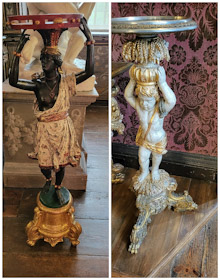
Skin pigmentation and figurines at Knole House in Kent

At some National Trust properties, figurines with dark skin pigmentation, such as the one on the left (first picture), are labelled with an apologetic warning that the figurine depicts a person of colour in a demeaning pose. Not so in Knole House, near Sevenoaks in Kent. In the same room, also without a label, there is a figurine depicting a person with pale skin in the same demeaning pose.

It was the fashionable thing to do

I AM READING A most fascinating book at present (June 2023). Published in 1984, it is “Staying Power: The History of Black People in Britain” by Peter Fryer (1927-2006). In it, the author described how during the 18th century, it was fashionable for wealthy British people living in England to have at least one ‘black’ servant (or slave, in some cases) amongst their teams of domestic staff. Including a black servant in a portrait painting was believed to add to the perceived status of the subject being portrayed. Putting it crudely, just as sporting a Prada handbag or driving a Maserati is supposed to enhance the status of their owners today, exhibiting the ‘black’ servant did the same for the vanity of the wealthy in the 18th century. Sadly, many wealthy British people in the 18th century did not see the ‘black’ servants as human beings but as valued possessions or accessories.  

Today (3rd of June 2023), we paid a visit to Hogarth’s House in Chiswick. Located next to the busy A4 dual carriageway and the often-congested Hogarth Roundabout, it is now hard to believe that in 1749, the artist William Hogarth (1697-1764) bought this place to use as his country home. For, in those days this 17th century house was surrounded by countryside. The house and its garden are open to the public free of charge. The visitor gets to see a series of wood-panelled rooms, very much like those I have seen a friend’s 18th century house in the oldest street in Kensington. Unlike our friend’s house, the walls of the rooms of Hogarth’s former country place are lined with a large number the artist’s wonderful, printed works. Most of these depict scenes portrayed with many fine details. They express Hogarth’s satirical views of the life and behaviour of his contemporaries.

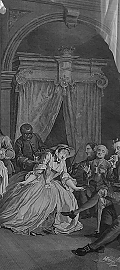
Some of the prints portray the lives of the poor and less well-off. A few depict life in ‘high society’. In several of the latter, there are a few black faces amongst the people in the pictures. All of them are obviously servants. In one of these prints, a black woman with her back facing the viewer can be seen attending to something at her white mistress’s foot. The lady is reclining, and she is looking up from a book propped in front of her. In another print, a black man is shown carrying a cup and saucer into the room filled with white people and there is also a black child playing with a small statue or toy. I examined all the prints on display and noticed that it was only those with scenes of the lives of rich people that included black people. The people in all the other prints were white only.

The depiction of black people with rich people in Hogarth’s satirical depictions of life in 18th century England helps to back up what I have read so far in Fryer’s book. That said, and I might not have noticed what I have described had I not been reading the book, Hogarth’s House is a delightful place to visit. It does not offer refreshments but the lovely café at Chiswick House is only a few minutes’ walk away.

A chance meeting in north London

During the late 1990s, our then young daughter had a baby-sitter called Bridie. Although Bridie was already well into her eighties when we first met her, she was a remarkably sprightly lady. Born in a rural part of the west of Ireland, she came to England in her late teens. On arrival in England, she and her husband were cared for by the Salvation Army in exchange for taking a pledge never to drink alcohol again. Bridie never reneged on this promise.  To earn a living in London, where she settled, she became a domestic servant. Hearing that I had been brought up in northwest London’s Golders Green, she told me the following story.

War memorial clocktower in Golders Green

Sometime before WW2, Bridie was employed as a maid in a Jewish household in Golders Green. She looked after the family’s children and carried out many household duties. Even though it was not a particularly wealthy family, Bridie recalled that she wore uniforms when on duty. There was one outfit that she wore in daytime and in the evening, she changed into another. As she did with our daughter, Bridie became fond of the family’s two young sons.

Many years later, when Bridie had become a grandmother and our daughter’s baby-sitter, she used to spend her spare time travelling around London by bus (making use of her old age free bus pass).  One day, she was waiting for a bus at the stop closest to Golders Green’s Sainsbury’s (on the site of the Ionic cinema), when a well-dressed late middle-aged man in the queue said to her:

“Goodness! Is it you, Bridie? We have not seen each other for so many years.”

After a moment, Bridie realised that she was being addressed by one of the two boys, whom she had looked after in the house in Golders Green before the War. Just then, a bus arrived, and as her former charge was about to embark, he shouted:

“This is my bus. Are you taking it, Bridie?”

Bridie misheard what he had said, and by the time she realised, the bus had pulled away, leaving her at the bus stop. She told me that if she had known he was taking that bus, she would have joined him. As far as I know, she has never seen him again.