The photograph above is a simple example. Now a branch of Nando’s, this place in York Way (near Kings Cross station), which bears a ghost sign. It used to house a place where other refreshments were available long before Nando’s company was established.
SOUTH OF KENSINGTON Gardens, just west of the Royal Garden Hotel, there is a small green hut with a pitched roof beside Kensington Road. It is one of the thirteen remaining cabmen’s shelters dotted around central London, which were established by the Cabmen’s Shelter Fund (‘CSF’) in 1875 and are still maintained by this organisation. Back in those days, cab drivers could not leave a cab stand whilst they were parked there. This made it difficult for cab drivers to obtain food and drink whilst on duty.
The solution to this problem was devised by the newspaper editor George Armstrong (1836–1907) and Anthony Ashley-Cooper, 7th Earl of Shaftesbury (1801-1885). They conceived the idea of the shelters to provide cabdrivers with refreshment. By law, the shelters had to be no larger a horse and cart, which explains their small size. That way, they did not encroach on the carriageway too much. In the past, these shelters confined themselves to serving cabmen. More recently, members of the public can buy snacks and drinks at these huts, whose attendants are supposed to make a living from their shelters. Cabmen can eat within a shelter, but others can only use them for take-away refreshments.
Recently, when passing the shelter on Kensington Road, I noticed that there were a couple of menus attached to it. Next to them was a small blackboard on which the following was written in chalk:
“Till Rolls 3 for 2.50 Receipt pads 4 for 2£”
This is stationery for the exclusive use of taxicab drivers. I was pleased to see this because it means that although they are open to the public, they are still of special use to cabdrivers.
I have never sampled anything at a cabmen’s shelter, so have no idea of the quality provided. Years ago, when I was practising dentistry, one of my patients was a taxicab driver. He was a ‘foodie’ and told me that he knew great quality, reasonably-priced eating places all over London. I cannot recall that amongst the many places he told me about that there were any cabmen’s shelters.
WEST HAMPSTEAD, FORMERLY known as ‘West End’ in the time, before the 20th century, that Hampstead was a small town separated from London. Now, yet another of London’s numerous suburbs, West Hampstead has several churches as well as a synagogue. One of these places of worship, St James Church, is worth entering because it is not what it seems from its external appearance.
The large Parish Church of St James, built mainly with red bricks, was erected in about 1887 (www.lwmfhs.org.uk/parishes/6-middlesex/28-hampstead). It was designed by Sir Arthur William Blomfield (1829-1899), the fourth son of CJ Blomfield, Anglican Bishop of London between 1828 and 1856, who encouraged much new church building during the 19th century. This large church could seat 1000 people (www.british-history.ac.uk/vch/middx/vol9/pp145-152#h3-0007) and has some fine 19th century stained-glass windows.
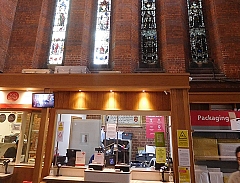
On entering the church through its electrically operated glass sliding doors, you will be surprised by what you find beneath its fine hammer beam timber ceiling. The west end of the nave is occupied by a post office, the first main-branch of a UK post office ever to be housed within a church. The north aisle of the church contains a children’s ‘soft play’ area, appropriately named ‘Hullabaloo’. The floor of the nave is filled with tables and chairs occupied by people of all ages, some enjoying refreshments from the church’s Sanctuary Café. All these things that you would not normally expect to find inside a church are part of The Sherriff Centre, a community organisation that began operating in 2014 (https://thesherriffcentre.co.uk/). The Centre’s activities also include a stationery store, a free food bank, live music as well as other events, free wi-fi, debt advice, and more.
Jesus is said to have thrown the moneychangers and others involved in commercial activity from the Temple in Jerusalem (“The Holy Bible”, John, Ch 2, v 13-16). However, he might have approved of the commercial activities within St James because profits from the sales outlets in the Centre are used to help finance charitable work. In addition to everything that I have already described about what goes on within St James, there is one more thing to mention. Despite the activities that you might not expect to find inside a church, regular religious Church of England services are held there. It is wonderful that St James, instead of becoming yet one more barely used Victorian church in London, has become a vibrant and beneficial part of a local community, catering to more than only just its by now small congregation.



 yamey
yamey 