
Blowing in Bermondsey

IT IS UNNECESSARY to travel from London to Venice to see masterpieces of glass bowing. You need only make your way to Bermondsey Street in south London where you will find London Glassblowing. It is both a gallery and workshop set up by Peter Layton, who is now over 80 years old and still creating beautiful artefacts. Layton was born in Prague and grew up in England. After studying ceramics at London’s Central School of Art and Design, he taught ceramics at the University of Iowa in the USA. It was there that he discovered glass blowing and took to it. When he returned to England in 1976, he established his London Glassblowing in London. It has been located at its present address for about 15 years. Before that, he was in Leather Yard. Apart from creating works of art in glass, he also teaches and mentors other glass blowers.

Whenever we visit Bermondsey Street, we make a point of visiting Layton’s establishment. Always the works on display are both beautiful and highly inventive. Occasionally, if we reach the place at the right time, we can watch glass blowers at work in the invariably hot workshop behind the gallery. Unlike the workshops we have visited on the island of Murano (near Venice), the works produced in Bermondsey Street – both sculptural and functional – are tastefully contemporary and often avant-garde.
The Apple of my eye in Regent Street

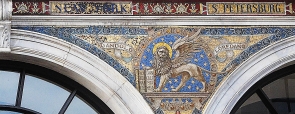
LONG BEFORE IT became the Apple Store on Regent Street in central London, I used to look at the colourful mosaics on its building’s façade. Running in a line along the top of the mosaics, which are above the four arches of the shopfront, are the names of several cities including St Petersburg. This used to intrigue me a lot in the years before Communist rule ended in Russia and the city was then called Leningrad.

The mosaics contain depictions of several coats-of-arms including and two lions, each resting a paw on an object. One of the lions has wings and rests its paw on an open book on whose pages are the words: “PAX TIBI MARCE ENVANGELISTA MEUS”. For, this creature is the lion of St Mark, symbol of Venice and its former empire. On both sides of the lion, there are depictions of streamers. One reads “DANDOLO” and the other “LOREDANO”. Both are the names of important patrician families in Venice. Two other crests also appear, one on each side of the winged lion and the two names. One is for the island of Murano and the other for the island of Burano. These two islands in the Lagoon of Venice, especially Murano, are known for their glassmaking activity.

The mosaics were originally installed when the Venetian glass-making company Salviati opened its store in this building, designed by GD Martin, on Regents Street in 1898. The business made both fine glassware and mosaics. Soon after the firm was founded in 1859, it began to be established in England. According to a company history (www.salviati.com/en/our-story/):

“It was also in London, on 21st December 1866, that the “Società Anonima per Azioni Salviati & C.” was established with the support of diplomat Sir Austen Henry Layard and historian William Drake.”

Fortunately, the lovely mosaic has survived and has been kept in good condition. I have always marvelled at it when wandering along Regent Street, but I wonder how many people rushing into Apple’s attractive looking shop notice it.