
YOU NEVER KNOW WHAT you might discover when you stop in a small English town or village. And wherever you halt, you are highly likely to find something intriguing. Camelford in Cornwall is no exception to this. We stopped there to buy meat from Steve Heard Quality Butchers, and their meat is so excellent that we have shopped there twice in the last few days. After our second visit to the shop, we strolled around Camelford and soon came across the Methodist Free Church, which is housed in a rather plain grey stone edifice. A small sign near its entrance advertised that there was an exhibition inside its entrance lobby. Luckily, the church was open, and we were able to discover something about Camelford’s missionary in China.
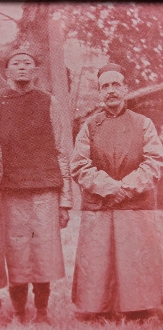
Samuel Pollard (1864-1915), the son of a Bible Christian Church preacher, was born in Camelford. After commencing a career in the British Civil Service, working in the Post Office Savings Bank in London’s Clapham, he was appointed a missionary to China in 1886. His change of career was prompted by his having attended a conference (The Southsea Methodist conference). In 1887, he set off for southwest China, where he became a Christian missionary amongst the Miao people. In 1891, he was posted to a newly opened Bible Christian mission station in Zhaotong. It was there that he began establishing a Christian movement amongst the Big Flowery Miao (aka ‘A-Hmao’) people, who live in the cold, rugged, mountainous areas of southwest China. In Zhaotong, Samuel married Emma Hainge, and they had four sons.
During the last 10 years of his life, Samuel converted 80% of the 400,000 Big Flowery Miao to Christianity. According to a Methodist website (www.myunitedmethodists.org.uk/content/people/ministers/sam-pollard):
“Sam Pollard worked from a missionary base in Zhaotong but travelled extensively around the province of Yunnan sometimes alone but usually with other missionaries or with Christian converts. From 1897 to 1904 Sam’s missionary efforts was focused on anyone who would listen. He and his colleagues held services which were often in the open air in a town centre or village market place. To gain attention he started off either banging a gong or attempting to play a concertina. Then, in order to have more effect, he blew a trumpet but he always maintained that he had little or no musical ability. As his reputation spread there was less need for this noisy introduction and simply standing up in a crowded place or advertising a meeting by word of mouth was enough. Sometimes many hundreds of people would attend and occasionally up to 3000!”
Apart from many adventures whilst living in, and travelling around, China, Pollard, who learned Mandarin at China Inland Mission training school at Ganking, is best known for a linguistic achievement. Along with several colleagues, he developed a script for the language spoken by the Big Flowery Miao. It has become known as ‘Pollard Script’. The Methodist website explained:
“‘Pollard Script’ was developed by Sam and several of his colleagues to help the A-Hmao to read in their own language. This proved a difficult task because many of the words use different tones rather than phonetics. He took inspiration from a script that had been developed by a Methodist Missionary working with North American Indians and also adapted Pitmans shorthand to indicate the level of the voice tones. Sam managed to translate much of the New Testament into this script before he died and there have been some improvements since, but it is still known as ‘Pollard Script’ and is also used by several other ethnic groups such as those that speak Tibeto-Burman languages.”
Samuel died of typhoid whilst trying to help a Chinese child suffering from that illness. Returning to the website already mentioned:
“The A-Hmao, Big Flowery Miaos still venerate Samuel Pollard as their spiritual leader. Their deep respect has survived Communism and the extremes of the Cultural Revolution right through to today. And it all started with Sam’s birth in the Bible Christian Manse in Victoria Road 150 years ago in Camelford in Cornwall!”
A recent President of China (‘reigned’ from 2003 to 2013), Hu Jintao, restored Pollard’s grave (at Weining Yi in Miao Autonomous County). He is said to have asked his officials to be like Pollard and support the poor.
Had it not been for the excellence of the butcher in Camelford, we would not have returned to the town. Because the town centre is quite picturesque, we spent some time looking around, and, as luck would have it, we stumbled across an exhibition about a remarkable man, of whom I had never heard.

 yamey
yamey 