
Happy Christmas
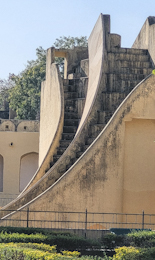
IT LOOKS LIKE MODERN sculpture at first sight. On closer examination, these fascinatingly shaped objects have carefully constructed scales, like the markings on a ruler or a protractor, attached to them. They are astronomical instruments that were constructed for the Rajput king Sawai Jai Singh (1688-1743), and they were completed by 1734. Together, they comprise Jaipur’s Jantar Mantar (literally ‘calculating instruments’). They were used to construct what has turned out to be extremely accurate astronomical tables.
Sawai Jai Singh was very interested in mathematics, astrology, astronomy, architecture, and literature. He studied scientific works by, for example, Ptolemy, Newton, Flamstead, and Euclid. He had Euclid’s “Elements of Geometry” translated into Sanskrit. His interest in astronomy might have been inspired in1702 by his tutor Jagannatha Samrat.
The Jantar Mantar in Jaipur contains 18 separate stone instruments with metal attachments . My knowledge of astronomy is minimal. So, I will not try to explain for what purpose each was, and still can be, used. A Wikipedia page (https://en.m.wikipedia.org/wiki/Jantar_Mantar,_Jaipur) can help with explaining their purposes.
To a visitor, like me, who is unversed in astronomy, and to those who are familiar with modern astronomical instruments, the Jantar Mantar presents the visitor with one of the most extraordinary looking tourist sights that India has to offer. It is not unique. In addition to the one in Jaipur, Sawai Jai Singh built four others in northern India. However, the one at Jaipur is the largest and best preserved.
If one did not know its purpose, the Jantar Mantar observatory compound would seem as if it is one of the world’s most superb sculpture parks.
 yamey
yamey 